
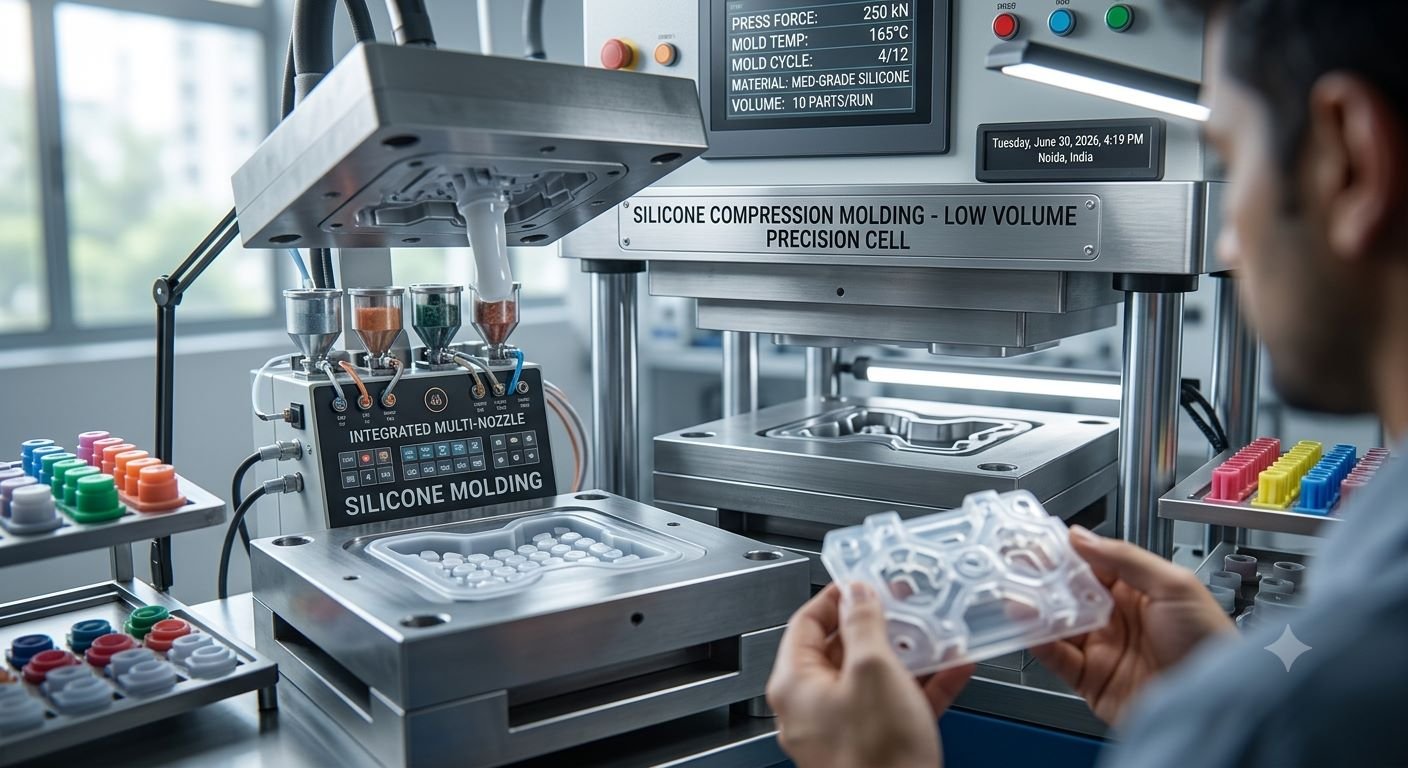
Manufacturers increasingly require components that offer flexibility, durability, heat resistance, and dimensional accuracy. Two manufacturing solutions that address these requirements are Silicone Compression Molding and low volume silicone molding.
Both processes help businesses manufacture high-quality silicone components for different production requirements. While compression molding is valued for its reliability and versatility, low-volume manufacturing provides flexibility when developing prototypes, testing new designs, or producing limited quantities.
Understanding these manufacturing methods can help businesses select the right production approach, manage costs, and achieve consistent product quality.
What Is Silicone Compression Molding?
Silicone Compression Molding is a manufacturing process used to create silicone components by placing a measured quantity of uncured silicone material inside a heated mold cavity. Pressure and heat are applied to shape and cure the material into the required design.
Once the curing process is complete, the mold opens, and the finished component is removed.
This technique is suitable for producing products with different shapes, sizes, thicknesses, and functional requirements.
How Does Silicone Compression Molding Work?
The manufacturing process generally involves the following steps:
-
Material Preparation: Silicone rubber is selected according to the product’s mechanical, thermal, and chemical requirements.
-
Material Loading: A measured amount of uncured silicone is placed inside the mold cavity.
-
Mold Closing: The mold is closed and pressure is applied.
-
Heating and Curing: Heat activates the curing process, allowing silicone to develop its required properties.
-
Component Removal: The cured component is removed from the mold.
-
Finishing and Inspection: Excess material is trimmed, and the component is checked for dimensional accuracy and quality.
Proper control of temperature, pressure, curing time, and material quantity helps manufacturers achieve consistent results.
What Is Low Volume Silicone Molding?
Low volume silicone molding is a manufacturing approach designed for producing smaller quantities of silicone components without immediately investing in large-scale production systems.
It is particularly useful for businesses that need prototypes, product samples, specialized components, or limited production runs.
Instead of committing to expensive mass-production tooling, manufacturers can use suitable molds and production methods to create smaller batches.
Key Benefits of Low Volume Silicone Molding
Businesses choose low volume silicone molding for several important reasons:
-
Lower Initial Investment: Smaller production requirements can reduce initial tooling and manufacturing expenses.
-
Design Flexibility: Product designs can be adjusted more easily before mass production.
-
Faster Product Development: Manufacturers can produce samples for testing and evaluation.
-
Reduced Inventory: Businesses can manufacture quantities based on actual demand.
-
Customization: Different shapes, sizes, colors, and silicone specifications can be accommodated.
-
Market Testing: Companies can evaluate customer responses before increasing production.
These advantages make low-volume manufacturing valuable for startups, product developers, and established companies introducing new products.
Silicone Compression Molding vs. Low Volume Silicone Molding
Although both approaches can support silicone product manufacturing, they serve different production needs.
|
Comparison Factor |
Silicone Compression Molding |
Low Volume Silicone Molding |
|---|---|---|
|
Main purpose |
Forming silicone components under heat and pressure |
Producing smaller quantities |
|
Production scale |
Small to large, depending on tooling |
Limited batches |
|
Tooling |
Requires compression molds |
May use simpler or specialized tooling |
|
Flexibility |
Depends on mold design |
Generally offers greater production flexibility |
|
Applications |
Seals, gaskets, and industrial components |
Prototypes and customized parts |
|
Best suited for |
Repeatable molded components |
Product development and limited demand |
An important distinction is that compression molding describes a manufacturing process, whereas low-volume molding describes a production quantity or strategy. Compression molding can also be used for low-volume production.
Industries That Use Silicone Molding Solutions
Silicone molding supports many industries because silicone rubber offers useful physical and performance characteristics.
1. Automotive Industry
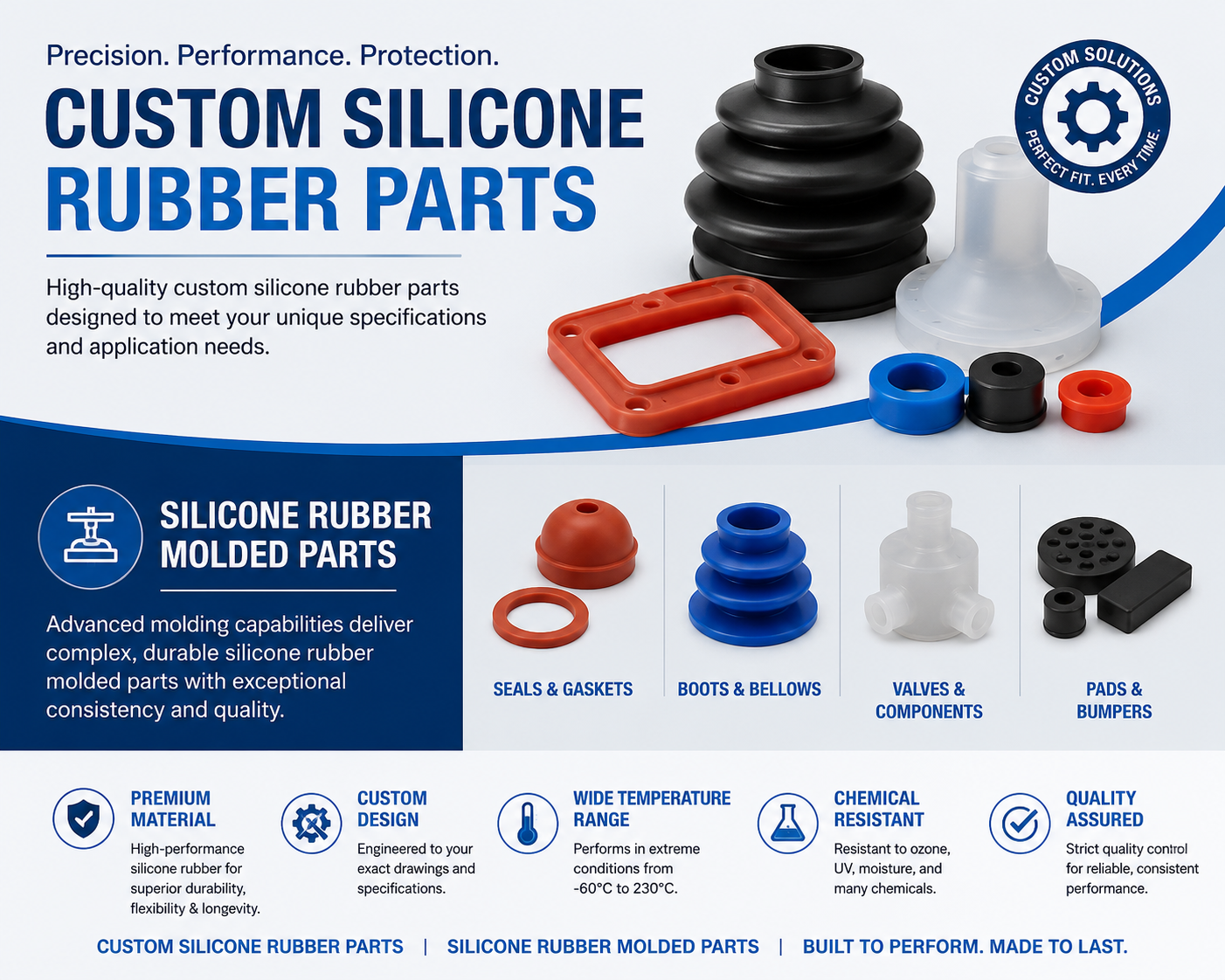
Automotive manufacturers use molded silicone components for seals, gaskets, vibration-resistant parts, protective covers, and insulation components. These products must withstand temperature changes and demanding operating environments.
2. Medical and Healthcare
Medical product manufacturers use appropriately specified silicone components in tubing, seals, device housings, and other specialized applications. Material selection and regulatory compliance are essential for medical applications.
3. Electronics Industry
Silicone components provide insulation, cushioning, sealing, and environmental protection for electronic assemblies.
4. Industrial Manufacturing
Industrial equipment frequently requires durable silicone gaskets, diaphragms, protective parts, and sealing components that perform reliably under challenging conditions.
5. Consumer Products
Customized silicone products are also used in household equipment, kitchen accessories, wearable products, and specialized consumer applications.
How to Choose the Right Silicone Molding Method
Selecting a suitable manufacturing solution depends on product specifications, budget, expected demand, and performance requirements.
Consider these factors before making a decision:
-
Production Quantity: Estimate the number of components required initially and over time.
-
Material Requirements: Identify the necessary hardness, flexibility, temperature resistance, and chemical compatibility.
-
Product Complexity: Evaluate whether the component has detailed shapes, thin walls, or specialized features.
-
Tooling Budget: Consider the initial mold investment and long-term production expenses.
-
Quality Standards: Establish acceptable tolerances and inspection requirements.
-
Future Demand: Select a process that can accommodate potential production increases.
Working with an experienced silicone molding manufacturer can help simplify these decisions.
Important Factors Affecting Silicone Molding Quality
High-quality silicone components require more than selecting the correct manufacturing process. Several technical factors influence the final result.
-
Silicone Grade: Different silicone formulations provide different mechanical and thermal properties.
-
Mold Design: Proper cavity design helps ensure accurate component dimensions.
-
Curing Conditions: Temperature and curing time influence the finished material properties.
-
Flash Control: Appropriate mold alignment helps reduce excess material.
-
Surface Finish: Mold quality influences the appearance and functionality of components.
-
Quality Inspection: Dimensional checks and performance testing help maintain manufacturing consistency.
Frequently Asked Questions
1. What is Silicone Compression Molding?
It is a manufacturing process in which uncured silicone is placed into a heated mold and shaped using pressure and heat.
2. What is low volume silicone molding?
It is an approach to producing smaller quantities of silicone components for prototypes, customized products, and limited production requirements.
3. Is compression molding suitable for small production runs?
Yes. Compression molding can be suitable for smaller batches when the tooling cost and production requirements make it practical.
4. What industries use silicone compression molding?
Automotive, healthcare, electronics, aerospace, industrial equipment, and consumer goods industries commonly use molded silicone components.
5. What are the advantages of low volume silicone molding?
Its advantages include reduced initial investment, production flexibility, customization, and easier product development.
6. Which silicone materials are used in molding?
Common materials include high-consistency rubber (HCR), liquid silicone rubber (LSR), and other application-specific silicone formulations.
7. Can silicone molding produce customized components?
Yes. Manufacturers can develop customized components with different shapes, dimensions, hardness levels, and colors.
8. How does mold design affect silicone product quality?
Mold design influences dimensional accuracy, material flow, surface finish, flash formation, and overall component consistency.
9. Is low-volume production suitable for startups?
Yes. It allows startups to develop products, test designs, and evaluate market demand without immediately committing to large production quantities.
10. How can businesses select a reliable silicone molding manufacturer?
Businesses should evaluate manufacturing experience, material expertise, tooling capabilities, quality-control procedures, customization options, and production support.






Leave a Reply