
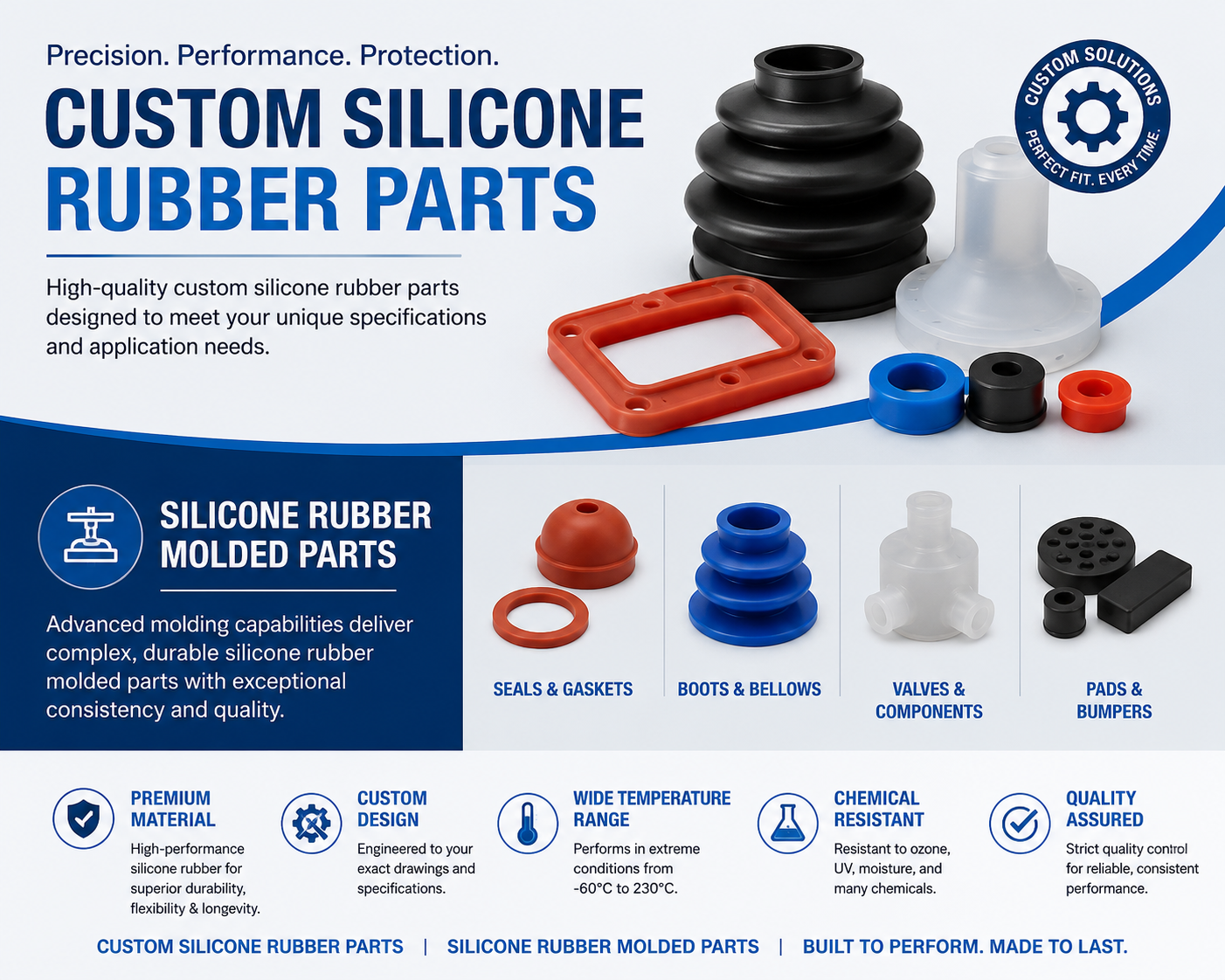
Every manufacturing industry depends on components that deliver accuracy, strength, and consistent performance. From small electronic devices to heavy industrial machinery, individual components play an important role in determining the reliability of finished products. Silicone rubber has become a preferred material for many applications because of its flexibility, temperature stability, and resistance to environmental conditions.
Manufacturers increasingly invest in custom silicone rubber parts to develop components that match specific engineering requirements. These products can be designed for unique dimensions, specialized operating environments, and different functional purposes. Instead of adjusting equipment to accommodate standard components, businesses can obtain silicone solutions that fit their original product designs.
At the same time, silicone rubber molded parts have created new opportunities for precision manufacturing. They allow manufacturers to produce detailed shapes, functional designs, and repeatable components for different industrial applications.
How Customized Silicone Components Support Product Development
Product development requires materials that can adapt to different technical and functional demands. Silicone rubber offers excellent flexibility, making it suitable for components that need to bend, compress, seal, or absorb movement.
Custom silicone rubber parts can be developed according to engineering drawings, product samples, and specific performance requirements.
Some popular customized solutions include:
-
Silicone protective sleeves for sensitive equipment.
-
Rubber gaskets for preventing leakage.
-
Flexible seals for machinery and appliances.
-
Silicone plugs and caps for component protection.
-
Vibration-absorbing rubber mounts.
-
Custom diaphragms for mechanical systems.
These components help manufacturers improve product compatibility while reducing problems caused by incorrectly sized or unsuitable materials.
What Makes Silicone Rubber Molded Parts Different?
The manufacturing process plays a major role in determining the accuracy and functionality of silicone products. Silicone rubber molded parts are produced by placing silicone material into a specially designed mold and allowing it to cure under controlled conditions.
The mold determines the component’s shape, dimensions, and surface features.
Unlike products made through simple cutting or fabrication, molded components can include detailed designs, grooves, openings, and integrated features.
Important advantages include:
-
Consistent component dimensions.
-
Greater freedom in product design.
-
Suitable production methods for complex shapes.
-
Repeatable manufacturing results.
-
Options for different colors and material hardness.
-
Reduced dependence on secondary shaping operations.
These characteristics make molded silicone technology valuable for businesses developing specialized industrial products.
Important Factors That Influence Silicone Product Quality
Not every silicone component performs in the same way. Its final properties depend on material selection, manufacturing conditions, and product design.
Material Hardness
Hardness determines how soft or firm a silicone component feels. Manufacturers select different hardness levels depending on whether a product needs compression, flexibility, or structural support.
Temperature Requirements
Silicone materials are available in different formulations designed for specific temperature conditions. Selecting the correct grade helps maintain product performance during heating and cooling cycles.
Dimensional Accuracy
Components used in precision equipment require accurate measurements. Proper mold design and production controls help achieve the required dimensions.
Environmental Exposure
Moisture, ultraviolet radiation, chemicals, and mechanical stress can influence component performance. Material compatibility should be evaluated before production.
Design Compatibility
A well-designed component should fit the surrounding equipment without unnecessary pressure, gaps, or deformation.
Considering these factors helps businesses obtain dependable custom silicone rubber parts for demanding applications.
Industries That Depend on Precision Silicone Manufacturing
Silicone components are used in multiple sectors because manufacturers can adapt their properties to different functional requirements.
1. Automotive Manufacturing
Automotive systems require components that can tolerate vibration, temperature changes, and continuous operation. Silicone rubber is used in selected seals, protective covers, electrical insulation components, and flexible connections.
2. Electronics and Electrical Equipment
Electrical manufacturers use silicone components to provide insulation and protection. Customized designs can support connectors, switches, control panels, and sensitive electronic assemblies.
3. Medical Equipment Manufacturing
Medical equipment manufacturers use appropriately tested silicone materials in selected device components, seals, and tubing. The material grade must meet the relevant biocompatibility and regulatory requirements.
4. Industrial Machinery
Industrial machines require components that support sealing, cushioning, and equipment protection. Silicone rubber molded parts can be manufactured for specialized machinery according to operating specifications.
5. Food Processing Equipment
Suitable food-contact silicone materials are used in equipment seals, gaskets, and other components. Manufacturers should verify compliance with applicable food-contact standards.
How to Select the Right Silicone Manufacturing Method
Different manufacturing techniques are suitable for different product designs and production volumes.
|
Manufacturing Method |
Main Characteristics |
Suitable Applications |
|---|---|---|
|
Compression molding |
Uses heat and pressure to shape silicone |
Gaskets and seals |
|
Injection molding |
Injects silicone into a mold cavity |
Detailed, high-volume components |
|
Transfer molding |
Transfers material into mold cavities |
Specialized molded components |
The correct method depends on design complexity, material formulation, production quantity, and dimensional requirements.
For businesses ordering silicone rubber molded parts, discussing these factors with the manufacturer can help determine an efficient production approach.
Why Businesses Should Invest in Customized Silicone Solutions
Standard rubber components may not always provide the correct dimensions or functionality for specialized equipment. Customized manufacturing helps overcome these limitations.
Here are several reasons businesses consider customized silicone products:
-
Better product integration: Components are designed around specific equipment requirements.
-
Improved functionality: Material properties can be selected according to the intended application.
-
Design flexibility: Unique shapes and configurations can be manufactured.
-
Consistent production: Proper tooling and quality checks support repeatability.
-
Application-specific performance: Products can be developed for particular environmental and mechanical conditions.
Well-engineered custom silicone rubber parts can contribute to improved assembly quality and more reliable equipment operation.
Frequently Asked Questions
1. What are custom silicone rubber parts mainly used for?
They are used for sealing, insulation, cushioning, protection, and flexible connections in different industrial products.
2. How are silicone rubber molded parts manufactured?
They are produced by shaping silicone material inside molds using compression, injection, or transfer molding techniques.
3. Can silicone components be manufactured in different colors?
Yes. Suitable pigments can be added to silicone formulations to achieve different colors according to product requirements.
4. What determines the hardness of silicone rubber?
Hardness depends on the silicone formulation and material specifications selected during manufacturing.
5. Are custom silicone rubber parts suitable for outdoor applications?
Yes, appropriate silicone grades can offer resistance to weathering, moisture, and ultraviolet exposure.
6. Can silicone molded components have complex shapes?
Yes. Proper mold engineering allows manufacturers to create detailed shapes with grooves, openings, and specialized features.
7. Which industries use silicone molded products?
Automotive, electronics, healthcare, food processing, industrial machinery, and consumer appliance manufacturers use silicone components.
8. Are silicone rubber molded parts suitable for bulk manufacturing?
Yes. Injection molding and other suitable processes can support repeatable production in larger quantities.
9. What information is required to manufacture customized silicone products?
Manufacturers generally require product drawings, dimensions, material specifications, hardness requirements, samples, and estimated order quantities.
10. How can I find a reliable silicone rubber manufacturer?
Evaluate manufacturing experience, material knowledge, customization capabilities, quality inspection procedures, and production capacity.



Leave a Reply