
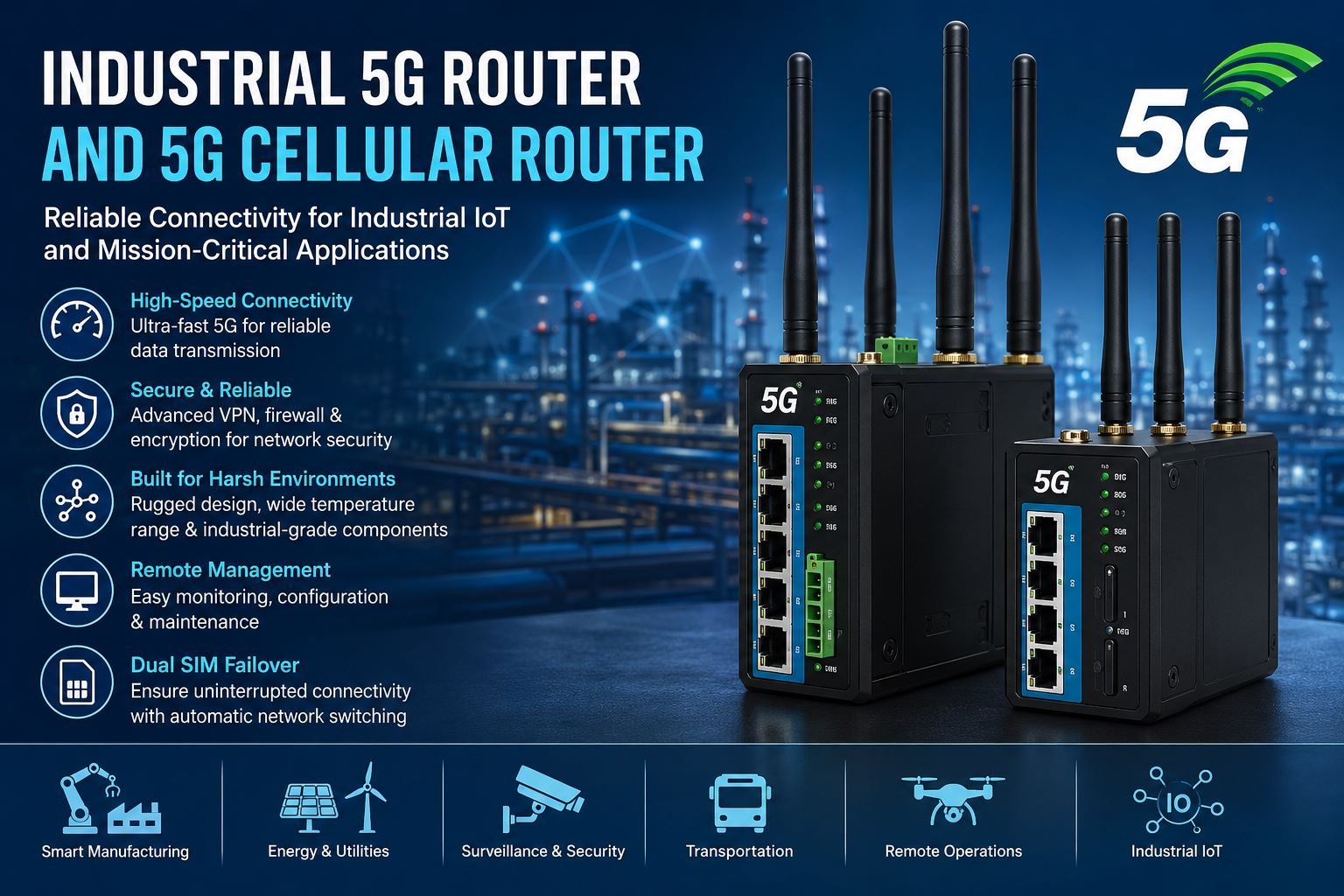
Reliable internet connectivity has become essential for modern industries. From automated manufacturing plants to smart warehouses, transportation systems, and remote monitoring facilities, businesses need fast, stable, and secure communication networks. Traditional wired connections and older wireless technologies may not always provide the flexibility required by today’s industrial operations. This is where advanced 5G technology makes a significant difference.
An industrial 5G router provides high-speed wireless connectivity for industrial equipment, machines, sensors, and monitoring systems. Similarly, a 5G cellular router allows businesses to connect multiple devices through cellular networks without depending entirely on traditional broadband infrastructure.
Both technologies support digital transformation by improving communication, operational efficiency, and network reliability.
What Is an Industrial 5G Router?
An industrial 5G router is a networking device designed to deliver high-speed internet connectivity in demanding industrial environments. Unlike standard home or office routers, it is generally built to withstand challenging operating conditions, including temperature variations, vibration, dust, and continuous operation.
These routers use 5G cellular networks to transfer information between industrial devices and cloud-based platforms.
Key features include:
-
High-speed 5G connectivity.
-
Rugged construction for industrial environments.
-
Secure wireless communication.
-
Ethernet and Wi-Fi connectivity options.
-
Remote network management.
-
Support for IoT devices and automation systems.
An industrial 5G router is particularly useful in facilities where installing traditional network cables is expensive, complicated, or impractical.
Understanding a 5G Cellular Router
A 5G cellular router is a networking solution that connects devices to the internet through a fifth-generation cellular network. It typically uses a SIM card or supported cellular subscription to establish a wireless connection.
Businesses can use these routers to provide internet access to computers, cameras, sensors, industrial controllers, and other connected equipment.
Unlike conventional broadband routers, cellular routers can operate in locations where fixed-line internet connections are unavailable.
Common advantages include:
-
Flexible network installation.
-
High-speed wireless data transmission.
-
Reduced dependence on wired infrastructure.
-
Support for multiple connected devices.
-
Reliable communication in remote locations.
-
Easy integration with IoT applications.
Why Are Industrial 5G Routers Important for Modern Industries?
Industrial businesses increasingly depend on real-time information to manage production, monitor equipment, and improve workplace efficiency.
An industrial 5G router helps establish communication between machines, control systems, and monitoring platforms.
Here are some important applications.
1. Smart Manufacturing
Manufacturing facilities use connected machines, sensors, and automated production equipment. A reliable industrial network helps these systems exchange information and coordinate operations.
2. Remote Equipment Monitoring
Industrial operators can monitor equipment performance, operating conditions, and system alerts from remote locations.
3. Warehouse Automation
Automated guided vehicles, inventory systems, and connected monitoring devices benefit from flexible wireless connectivity.
4. Transportation and Logistics
A 5G cellular router can support communication between fleet management platforms, tracking devices, and transportation equipment.
5. Energy and Utilities
Power stations, renewable energy facilities, and utility networks can use cellular connectivity to transmit operational information from distributed locations.
Key Features to Consider Before Choosing a 5G Router
Selecting the right networking equipment requires understanding your business requirements.
Consider these important features:
-
Network compatibility: Check whether the router supports the 5G bands and cellular operators available in your region.
-
Connectivity ports: Look for suitable Ethernet, serial, and other interfaces required by your equipment.
-
Security: Consider firewall protection, VPN support, authentication, and firmware updates.
-
Environmental protection: Industrial installations may require wider temperature tolerances and appropriate enclosure ratings.
-
Remote management: Centralized monitoring makes it easier to maintain multiple devices.
-
Antenna support: External antenna options can improve connectivity where signal conditions are challenging.
Industrial 5G Router vs. 5G Cellular Router
Although these terms are sometimes used interchangeably, they describe slightly different aspects of networking equipment.
| Feature | Industrial 5G Router | 5G Cellular Router |
|---|---|---|
| Primary focus | Industrial applications | Cellular internet connectivity |
| Construction | Often ruggedized | Depends on model |
| Connectivity | 5G and industrial interfaces | 5G cellular connectivity |
| Applications | Manufacturing and automation | Business and remote connectivity |
| Environment | Designed for demanding conditions | Indoor or outdoor, depending on design |
| Management | Often includes industrial monitoring | Depends on manufacturer |
The important distinction is that an industrial 5G router is defined partly by its industrial design and application, while a 5G cellular router is defined by its cellular connectivity. One device can belong to both categories.
How to Select the Right Router for Your Business
Choosing suitable networking equipment can improve long-term performance and reduce connectivity problems.
Follow these steps:
-
Identify your requirements: Determine how many devices need connectivity and what applications they will support.
-
Evaluate network coverage: Check local 5G availability, supported frequency bands, and signal quality.
-
Check compatibility: Ensure the router supports your existing machines, controllers, and networking infrastructure.
-
Review security features: Prioritize secure remote access and network protection.
-
Consider future expansion: Select equipment that can accommodate additional devices and increasing data requirements.
A suitable 5G cellular router should match both current operational needs and future connectivity plans.
Benefits of Investing in Advanced 5G Connectivity
Modern cellular networking offers several benefits to industrial and commercial organizations.
-
Faster communication compared with many older cellular technologies.
-
Greater flexibility for network deployment.
-
Support for connected industrial equipment.
-
Better opportunities for remote monitoring.
-
Reduced dependence on fixed-line broadband.
-
Improved scalability for expanding operations.
However, actual performance depends on network coverage, signal strength, congestion, device capabilities, and service-provider conditions.
Frequently Asked Questions
1. What is an industrial 5G router used for?
It provides wireless internet connectivity for industrial machines, automation equipment, sensors, monitoring systems, and connected business applications.
2. How does a 5G cellular router work?
It uses a compatible SIM or cellular subscription to connect to a 5G network and distributes internet connectivity through supported interfaces such as Ethernet and Wi-Fi.
3. Is an industrial 5G router suitable for factories?
Yes. Ruggedized models are designed for industrial applications such as factory automation, equipment monitoring, and machine-to-machine communication.
4. What is the difference between a 4G and 5G router?
A 5G router supports fifth-generation cellular technology, which can offer higher speeds and lower latency than 4G under suitable network conditions.
5. Can a 5G cellular router replace broadband?
Yes, it can serve as a primary internet connection where cellular coverage and data plans meet business requirements. It can also provide backup connectivity.
6. Does an industrial 5G router require a SIM card?
Most cellular models require a compatible SIM or another supported cellular subscription to access the mobile network.
7. Can multiple devices connect to a 5G router?
Yes. Depending on the model, multiple devices can connect through Ethernet, Wi-Fi, or other supported interfaces.
8. Are industrial 5G routers suitable for remote locations?
Yes. They are useful for remote facilities where fixed broadband infrastructure is limited, provided suitable cellular coverage is available.
9. What security features should a 5G router have?
Important features include firewall protection, VPN functionality, secure authentication, access controls, and regular firmware updates.
10. How do I choose the best 5G cellular router?
Evaluate network compatibility, signal strength, supported interfaces, security, environmental specifications, and remote management capabilities.





Leave a Reply