
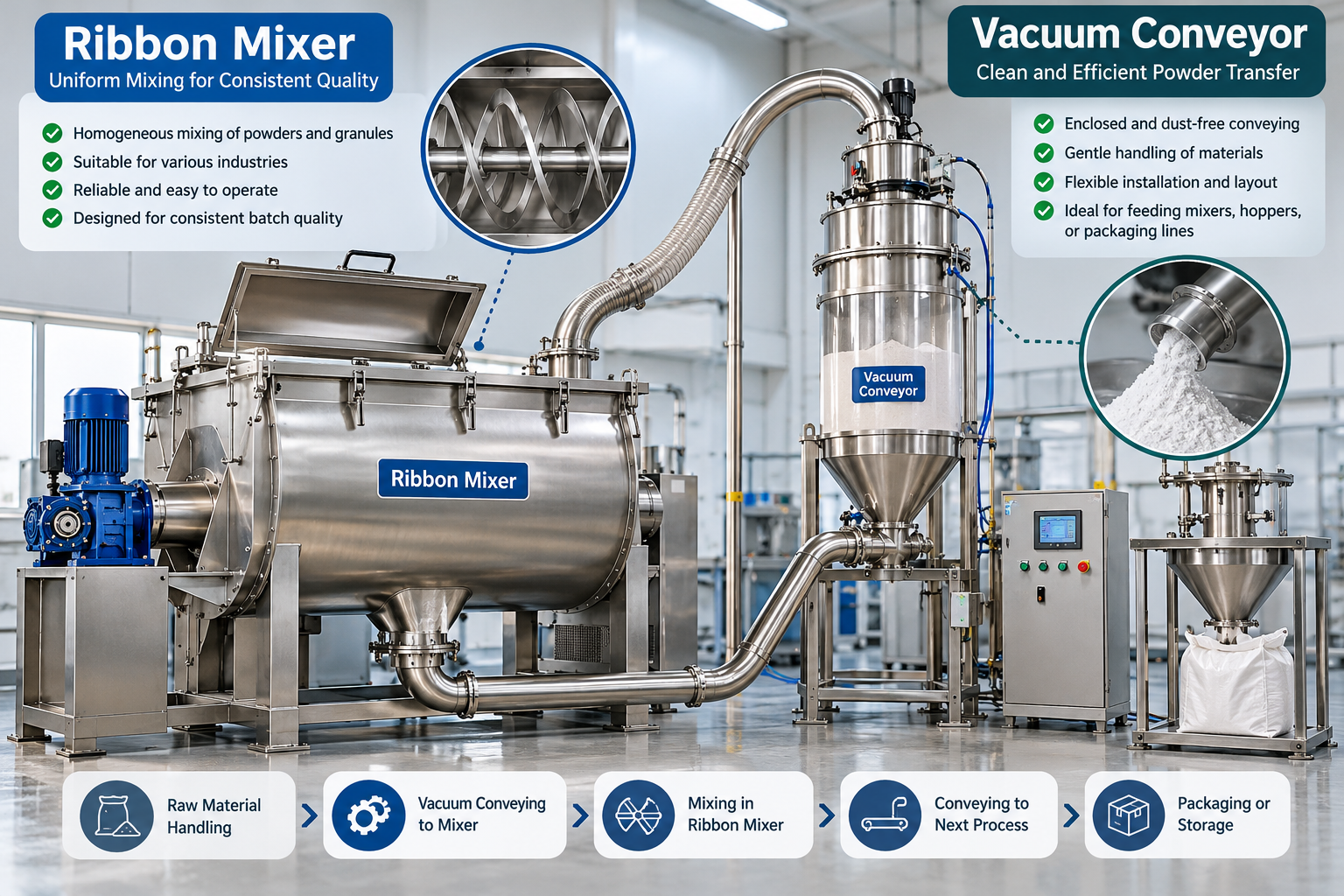
Consistent powder production depends on more than a powerful machine. Ingredients must arrive at the right place, blend evenly, and move onward without unnecessary spills or delays. A ribbon mixer and vacuum conveyor can support that sequence by handling two distinct tasks: blending and enclosed material transfer.
Why Mixing and Transfer Should Be Planned Together
A well-formulated batch can still lose efficiency when operators manually lift bags, move open containers, or repeatedly clean spilled powder. Likewise, quick conveying offers limited value if the upstream blend is inconsistent. Pairing a ribbon mixer with a vacuum conveyor can reduce handling steps and create a more controlled route between receiving, processing, and packing.
Layouts depend on powder behavior, volume, hygiene, and distance. Trial runs help reveal hidden handling challenges.
How a Ribbon Mixer Creates a Uniform Blend
A ribbon mixer typically uses a horizontal trough and a rotating shaft fitted with helical ribbons. The inner and outer ribbons move material in different directions, encouraging circulation throughout the batch. This action is useful for many dry powders and granular ingredients, including food premixes, detergents, and industrial formulations.
What Happens Inside the Mixing Chamber
Blend performance depends on fill level, mixing duration, ingredient density, and particle properties. The mixer should be evaluated using representative ingredients rather than relying exclusively on catalogue capacity.
Check the Finished Blend, Not Just the Clock
A longer cycle does not automatically improve quality. Sampling at suitable points and checking variation can establish an appropriate mixing time. Excessive processing may damage fragile material or encourage segregation after discharge.
How a Vacuum Conveyor Transfers Powders
A vacuum conveyor uses negative pressure to draw bulk solids through a closed pipeline toward a receiving vessel. The system separates conveyed material from the transport air, commonly through filtration, before releasing the product at its destination.
Because movement occurs inside enclosed tubing, a vacuum conveyor can limit airborne dust and reduce repeated manual handling. It can feed mixers, hoppers, or packaging lines.
Airflow, Filters, and Product Behavior
Conveying performance depends on material density, moisture, particle size, pipeline routing, and required throughput. Filters need appropriate cleaning and maintenance. An undersized vacuum conveyor can restrict production, while poorly planned routing may increase blockage or product degradation.
Creating a Connected Production Line
A conveyor can deliver measured ingredients into a mixing vessel through a suitable inlet. Once blending is complete, a properly designed discharge arrangement can direct product toward downstream conveying or packaging equipment.
A practical operating sequence is:
-
Verify the recipe, raw material identity, and batch instructions.
-
Transfer ingredients through a closed, compatible conveying path.
-
Run the ribbon mixer for the validated blending cycle.
-
Check blend quality using the approved sampling procedure.
-
Discharge and transfer the finished material while limiting exposure.
Automation can coordinate valves and sensors without sacrificing cleanability.
Ribbon Mixer Versus Vacuum Conveyor
| Consideration | Ribbon mixer | Vacuum conveyor |
|---|---|---|
| Primary duty | Blend bulk ingredients | Move material between points |
| Main mechanism | Rotating helical ribbons | Pressure difference and airflow |
| Key performance measure | Blend consistency | Reliable transfer rate |
| Main selection concern | Batch size and material behavior | Distance, routing, and dust properties |
A ribbon mixer influences formulation uniformity, whereas a vacuum conveyor influences how efficiently ingredients and blended materials reach the next stage.
Choosing Equipment for Your Material
Before selecting a ribbon mixer or vacuum conveyor, test realistic operating conditions rather than estimating from volume alone.
-
Material characteristics: Identify bulk density, flowability, abrasiveness, moisture sensitivity, and tendency to form lumps.
-
Production targets: Define batch size, cycles per shift, discharge expectations, and peak transfer demand.
-
Layout: Review inlet height, available floor space, pipe bends, access platforms, and maintenance clearance.
-
Quality requirements: Specify cleanability, contamination controls, traceability, and relevant industry standards.
-
Process testing: Request trials with actual ingredients and agree on measurable acceptance criteria.
Hygiene, Maintenance, and Operator Safety
Both machines require planned cleaning and inspection. Inspect ribbon clearance, seals, bearings, filters, hoses, and discharge valves according to manufacturer guidance. Product-contact surfaces should suit the application.
Combustible powders may create fire or explosion hazards. Risk assessment, grounding, dust control, and suitable protective measures must be designed for the specific material and facility. A vacuum conveyor does not eliminate these risks simply because its pipeline is enclosed. Similarly, a ribbon mixer requires guarding and safe isolation before access or maintenance.
Frequently Asked Questions
1. What does a ribbon mixer do?
A ribbon mixer blends compatible bulk solids by circulating material through a horizontal mixing chamber.
2. What does a vacuum conveyor do?
A vacuum conveyor transports powder through enclosed tubing using a pressure difference.
3. Can both machines work together?
Yes. A vacuum conveyor can feed ingredients to a ribbon mixer or transfer suitable blended product downstream.
4. Are they suitable for food production?
They may be, provided the design, materials, cleaning methods, and controls meet the application’s hygiene requirements.
5. Can a ribbon mixer process wet ingredients?
Some models support limited liquid addition, but suitability depends on the formulation and machine design.
6. Does vacuum conveying prevent dust completely?
It can reduce exposure, but connections, filters, maintenance, and discharge points still require control.
7. How is mixer capacity selected?
Consider working volume, bulk density, fill range, batch weight, and test results.
8. What affects conveyor capacity?
Particle characteristics, conveying distance, bends, air supply, and receiving equipment all influence performance.
9. How often should filters be checked?
Follow a maintenance schedule informed by pressure readings, material behavior, and operating hours.
10. Is automation essential?
No. Automation can improve repeatability, although a carefully designed manual workflow may also be suitable.





Leave a Reply