
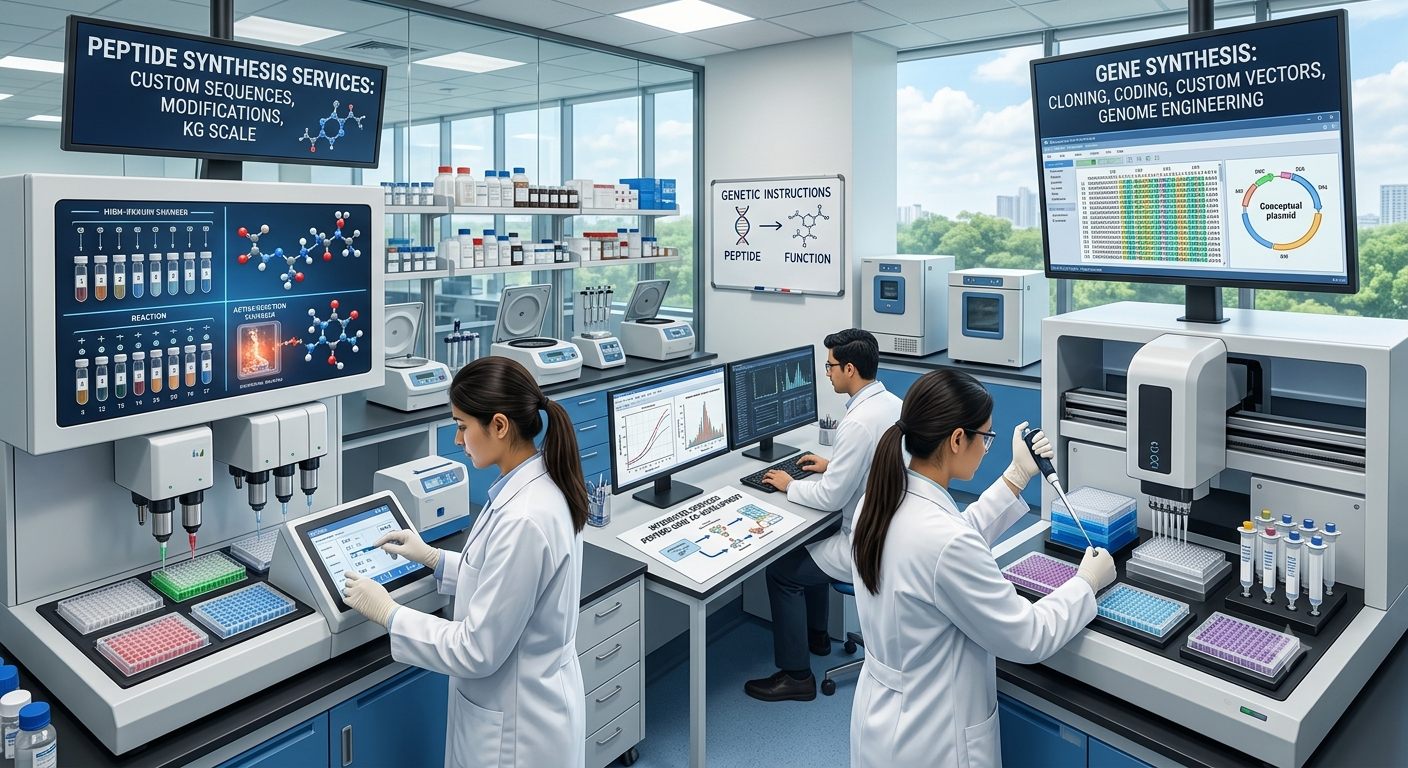
Biotechnology is advancing rapidly, creating new opportunities for scientific research, pharmaceutical development, and personalized medicine. Two important technologies supporting this progress are peptide synthesis services and gene synthesis. Both play a valuable role in developing new molecules, studying biological processes, and exploring innovative healthcare solutions.
Although these technologies serve different purposes, they complement each other in many research applications. Peptide synthesis focuses on producing specific chains of amino acids, while gene synthesis involves creating custom DNA sequences. Together, they help researchers investigate proteins, understand genetic functions, and develop promising biotechnology applications.
Whether you are working in pharmaceutical research, academic science, diagnostics, or biotechnology development, understanding these services can help you choose the right solution for your project.
What Are Peptide Synthesis Services?
Peptide synthesis services involve the laboratory production of peptides, which are short chains of amino acids connected through peptide bonds. These molecules are essential to numerous biological functions, including cell communication, hormone activity, immune responses, and metabolic regulation.
Researchers use custom peptides to investigate biological pathways, study protein interactions, and develop experimental compounds.
Professional peptide synthesis providers can offer different types of products and customization options, including:
-
Standard and custom peptide sequences.
-
Modified peptides with specific chemical properties.
-
Fluorescently labelled peptides.
-
Research-grade peptides.
-
High-purity peptides for specialized applications.
-
Peptide libraries for screening studies.
The final product can be customized according to sequence length, purity requirements, quantity, and intended research application.
How Does Peptide Synthesis Work?
Peptide production generally uses established chemical techniques to connect amino acids in a predetermined sequence.
One widely used approach is solid-phase peptide synthesis (SPPS).
The process typically involves:
-
Sequence selection: Researchers determine the required amino acid sequence.
-
Preparation: The appropriate starting materials and protective groups are selected.
-
Chain assembly: Amino acids are connected in the required order.
-
Cleavage: The completed peptide is separated from the solid support.
-
Purification: Unwanted substances and incomplete sequences are removed.
-
Quality testing: Analytical methods evaluate identity, purity, and other relevant characteristics.
Reliable peptide synthesis services combine suitable production methods with analytical quality control to deliver products that meet project specifications.
What Is Gene Synthesis?
Gene synthesis is the process of creating a specific DNA sequence using laboratory-based chemical synthesis and molecular biology techniques.
Instead of extracting an existing gene from a biological organism, scientists can design a DNA sequence according to their research requirements.
This technology makes it possible to create customized genetic materials for a wide range of applications.
Common uses include:
-
Protein expression research.
-
Genetic engineering.
-
Molecular biology experiments.
-
Synthetic biology.
-
Vaccine and therapeutic research.
-
Enzyme development.
-
Functional gene studies.
Gene synthesis provides researchers with greater flexibility when designing DNA constructs, including sequences that may be difficult to obtain from natural sources.
How Does the Gene Synthesis Process Work?
The gene synthesis workflow generally begins with a digital DNA sequence and progresses through laboratory production and verification.
The main stages include:
-
DNA sequence design: The desired genetic sequence is prepared.
-
Sequence optimization: Design considerations such as codon usage and sequence complexity are evaluated.
-
DNA assembly: Synthetic DNA fragments are combined to create the target sequence.
-
Cloning: The assembled DNA may be introduced into an appropriate vector.
-
Sequence verification: DNA sequencing confirms whether the final construct matches the intended design.
-
Delivery: The verified genetic material is prepared according to the customer’s requirements.
Professional gene synthesis providers use suitable quality-control procedures to help ensure sequence accuracy and product reliability.
Peptide Synthesis Services vs. Gene Synthesis
Although both technologies support biotechnology research, their products and functions are different.
| Comparison | Peptide Synthesis | Gene Synthesis |
|---|---|---|
| Main product | Peptide molecules | Synthetic DNA |
| Basic building blocks | Amino acids | Nucleotides |
| Primary purpose | Producing custom peptides | Creating custom DNA sequences |
| Common applications | Protein interaction studies | Genetic engineering |
| Quality testing | Purity and molecular identity | Sequence accuracy and DNA quality |
| Research focus | Peptide and protein-related studies | Gene and genetic studies |
Choosing between them depends on the biological material required for your experiment.
Applications of Peptide Synthesis Services and Gene Synthesis
Pharmaceutical Research
Pharmaceutical researchers use synthetic peptides and DNA constructs to investigate potential therapeutic targets, study biological mechanisms, and support early-stage drug discovery.
Biotechnology and Synthetic Biology
Both technologies are valuable in synthetic biology. Custom DNA sequences can support the development of engineered biological systems, while synthetic peptides help researchers examine molecular interactions.
Academic and Laboratory Research
Universities and research laboratories frequently use custom peptides and synthetic genes for experiments involving molecular biology, biochemistry, genetics, and protein function.
Diagnostic Development
Peptides and DNA sequences can contribute to the development and evaluation of diagnostic research tools, including assays designed to detect specific biological targets.
How to Choose the Right Synthesis Service Provider
Selecting a dependable laboratory partner is important for achieving consistent research outcomes.
Before choosing peptide synthesis services or a gene synthesis provider, consider these factors:
-
Technical expertise: Look for experience with your required sequence type and project complexity.
-
Quality assurance: Ask about analytical testing and quality-control documentation.
-
Customization: Confirm that the provider supports your sequence, modification, and quantity requirements.
-
Communication: Choose a team that provides clear project updates and technical support.
-
Delivery timelines: Understand the estimated production and shipping schedule.
-
Data confidentiality: Check how proprietary sequences and project information are protected.
A provider’s ability to understand your research objectives can be just as important as its production capabilities.
Frequently Asked Questions (FAQs)
1. What are peptide synthesis services?
They are specialized laboratory services that produce custom peptides from selected amino acid sequences for research and biotechnology applications.
2. What is gene synthesis used for?
Gene synthesis is used to create custom DNA sequences for genetic engineering, protein expression, synthetic biology, and molecular research.
3. Are peptide synthesis and gene synthesis the same?
No. Peptide synthesis produces amino acid chains, whereas gene synthesis produces DNA sequences.
4. What is solid-phase peptide synthesis?
Solid-phase peptide synthesis is a chemical technique that builds peptide chains step by step while the growing chain remains attached to a solid support.
5. Can peptides be customized?
Yes. Peptides can be customized according to amino acid sequence, length, purity, quantity, and certain chemical modifications.
6. How is gene synthesis different from gene cloning?
Gene synthesis creates DNA sequences through laboratory synthesis, while traditional gene cloning generally involves copying or transferring existing genetic material.
7. How is peptide purity measured?
Peptide purity is commonly evaluated using analytical techniques such as high-performance liquid chromatography (HPLC).
8. How is synthetic DNA verified?
DNA sequence verification is commonly performed using sequencing methods to compare the produced construct with the intended sequence.
9. Which industries use these services?
Pharmaceutical companies, biotechnology organizations, academic institutions, diagnostic developers, and research laboratories use these technologies.
10. How do I select the right synthesis service?
Evaluate technical capabilities, quality-control standards, customization options, documentation, communication, and delivery requirements.










Leave a Reply