
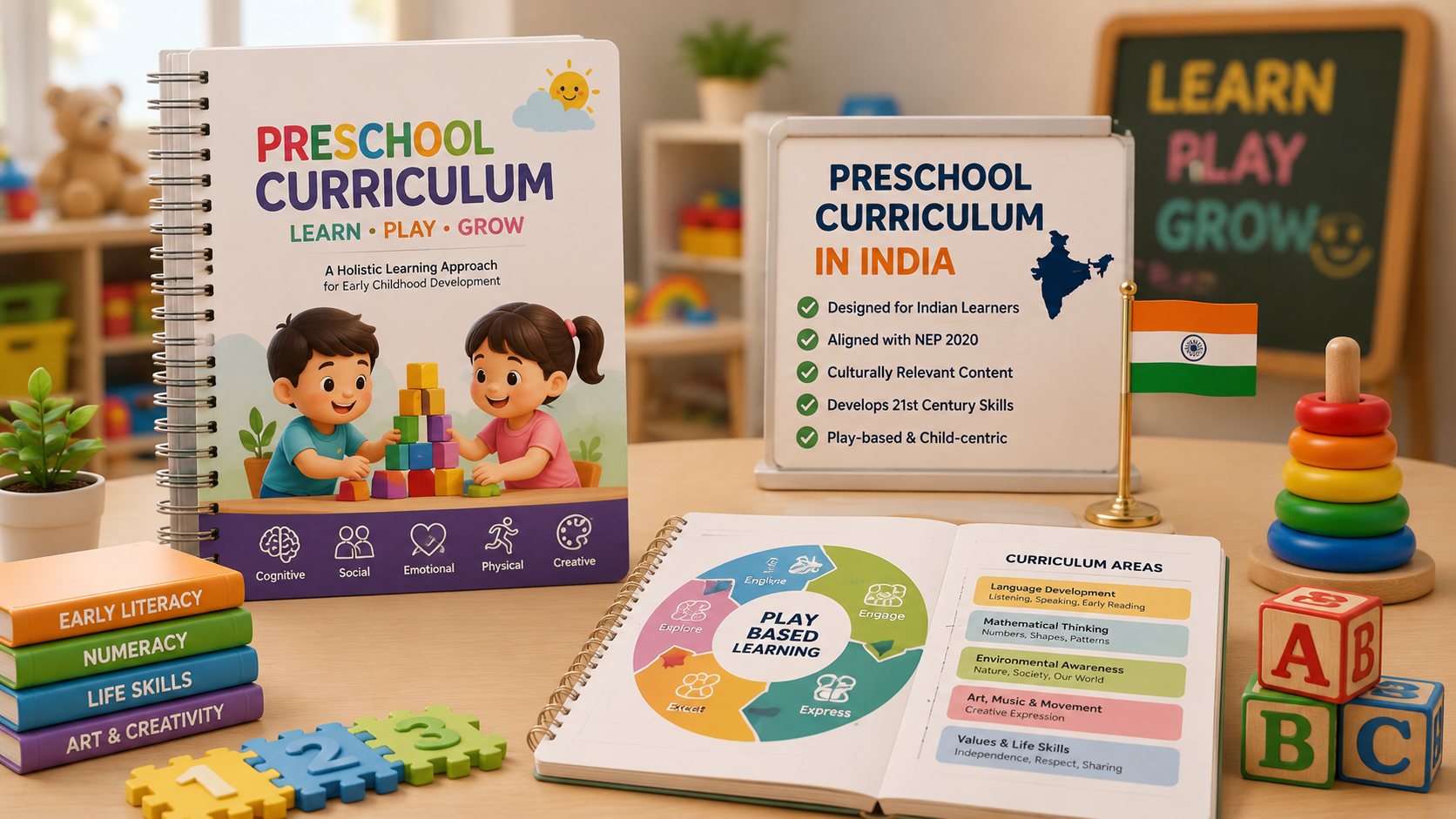
A child’s early years are among the most important stages of development. During this period, children begin discovering the world, developing communication skills, understanding emotions, and learning how to interact with others. A well-designed preschool curriculum plays an essential role in supporting these early learning experiences. It provides children with opportunities to explore, play, create, communicate, and develop essential life skills in an enjoyable environment.
In India, early childhood education is receiving increasing attention as parents and educators recognise the importance of structured yet flexible learning. A thoughtfully planned preschool curriculum in India focuses not only on academic readiness but also on physical, emotional, social, and cognitive development.
Understanding what makes a good curriculum can help parents choose the right preschool and enable educators to create meaningful learning experiences for young children.
What Is a Preschool Curriculum?
A preschool curriculum is a structured learning framework designed for young children, generally between three and six years of age. It outlines the activities, teaching methods, learning objectives, and experiences that support a child’s overall development.
Unlike traditional classroom education, preschool learning does not depend heavily on textbooks, examinations, or memorisation. Instead, children learn through practical activities, storytelling, music, games, creative projects, and exploration.
An effective curriculum encourages children to:
-
Develop language and communication skills.
-
Recognise numbers, shapes, and colours.
-
Improve creativity and imagination.
-
Build confidence and independence.
-
Understand basic social behaviour.
-
Develop physical coordination.
-
Explore their surroundings through observation.
The main objective is to make learning enjoyable while preparing children for their next educational stage.
Why Is a Preschool Curriculum in India Important?
India has a diverse educational environment, with children growing up in different languages, cultures, communities, and family backgrounds. Therefore, an effective preschool curriculum in India should be flexible, inclusive, and suitable for different learning abilities.
A balanced curriculum introduces children to essential concepts without creating unnecessary academic pressure.
Some important benefits include:
1. Cognitive Development
Activities involving puzzles, sorting, counting, and matching help children develop memory, logical thinking, observation, and problem-solving abilities.
2. Language Development
Storytelling, conversations, rhymes, and picture books introduce new vocabulary and improve listening and speaking skills.
3. Social Development
Group activities teach children how to share, cooperate, communicate, and respect others.
4. Emotional Development
Children learn to identify their feelings, express themselves, manage small challenges, and develop confidence.
5. Physical Development
Running, dancing, drawing, building blocks, and outdoor games support muscle development and coordination.
Key Learning Areas in a Modern Preschool Curriculum
A quality preschool programme includes different learning areas that contribute to the child’s overall growth.
1. Language and Literacy
Language learning begins with listening, speaking, and recognising familiar sounds. Children participate in storytelling, conversations, rhymes, picture reading, and vocabulary-building activities.
In multilingual Indian classrooms, children may be introduced to English, Hindi, and their regional language according to their age and learning environment.
2. Early Mathematics
Mathematical learning begins with simple everyday concepts rather than complicated calculations.
Children explore:
-
Numbers and counting.
-
Shapes and patterns.
-
Basic measurements.
-
Sorting and classification.
-
Comparing sizes and quantities.
These activities establish a foundation for future mathematical understanding.
3. Environmental Awareness
Children naturally enjoy exploring the world around them. A preschool curriculum introduces topics such as plants, animals, weather, seasons, family members, food, and community helpers.
Nature walks, gardening, and observation activities make these lessons more meaningful.
4. Art, Music, and Creativity
Creative activities help children communicate ideas and express their imagination. Drawing, painting, clay modelling, singing, dancing, and craftwork encourage originality and creative thinking.
5. Physical and Motor Skills
Physical development is equally important during early childhood. Activities such as jumping, balancing, running, colouring, threading, and building blocks improve gross and fine motor skills.
Popular Teaching Approaches Used in Preschool Education
Different educational approaches help teachers make classroom experiences interesting and effective.
| Teaching approach | Main focus | Learning experience |
|---|---|---|
| Play-based learning | Learning through play | Games, toys, and activities |
| Montessori approach | Independence | Self-directed practical tasks |
| Activity-based learning | Practical understanding | Experiments and projects |
| Experiential learning | Learning through experience | Exploration and observation |
| Theme-based learning | Connected concepts | Learning through weekly themes |
A good preschool curriculum may combine elements from different approaches instead of following one method rigidly. The selection should depend on children’s developmental needs and classroom objectives.
How Preschool Curriculum in India Supports NEP 2020
The National Education Policy (NEP) 2020 recognises the importance of Early Childhood Care and Education (ECCE). It highlights the foundational stage covering three years of preschool education and Classes 1 and 2.
The policy promotes developmentally appropriate, play-based, activity-based, and discovery-oriented learning.
A suitable preschool curriculum in India can support these objectives through:
-
Learning through stories, games, and activities.
-
Developing foundational language and numeracy skills.
-
Encouraging creative expression.
-
Supporting physical and emotional development.
-
Including local culture, traditions, and languages.
-
Creating inclusive learning opportunities.
The focus should remain on understanding and exploration rather than forcing children into formal academic routines too early.
How to Choose the Right Preschool Curriculum
Parents should look beyond attractive classrooms and promotional activities when selecting a preschool. The quality of its learning programme matters considerably.
Consider these important factors:
-
Age-appropriate activities: Lessons should match children’s developmental stages.
-
Qualified teachers: Educators should understand early childhood development.
-
Balanced learning: Academic readiness, creativity, and physical development should receive attention.
-
Safe environment: Classrooms and play areas should be clean and child-friendly.
-
Individual attention: Every child should receive encouragement according to their abilities.
-
Parent communication: Regular updates should help families understand their child’s progress.
-
Practical learning: Children should have opportunities to explore rather than simply memorise information.
Parents can also ask the school to explain its daily timetable, assessment methods, and classroom teaching practices.
Frequently Asked Questions About Preschool Curriculum
1. What is included in a preschool curriculum?
It generally includes language, early mathematics, environmental awareness, art, music, physical activities, social development, and creative learning.
2. What is the ideal age for starting preschool?
Many children begin preschool around three years of age, depending on their readiness and the school’s admission requirements.
3. Why is a preschool curriculum important?
It supports children’s cognitive, emotional, social, language, and physical development while preparing them for formal schooling.
4. How is the preschool curriculum in India different from traditional education?
It emphasises play-based and activity-based learning rather than relying mainly on textbooks, examinations, and memorisation.
5. Does a preschool curriculum include mathematics?
Yes. Children learn basic counting, shapes, patterns, sorting, and comparisons through practical activities.
6. Which languages should children learn in preschool?
Children should develop communication skills in familiar languages while gradually gaining exposure to other languages, depending on their environment.
7. What is play-based learning?
Play-based learning is an educational approach in which children develop knowledge and skills through games, toys, exploration, and interactive experiences.
8. How does NEP 2020 influence preschool education?
NEP 2020 encourages play-based, activity-based, and discovery-oriented learning during the foundational stage.
9. How can parents support preschool learning at home?
Parents can encourage storytelling, drawing, counting games, conversations, outdoor activities, and simple household tasks.
10. How can parents evaluate a preschool curriculum?
They should check teaching methods, teacher qualifications, classroom activities, safety standards, learning objectives, and progress-reporting practices.
11. Does preschool education prepare children for primary school?
Yes. It develops early literacy, numeracy, communication, independence, confidence, and social skills that support the transition to primary education.
12. Should preschool children receive homework?
Preschool learning should primarily happen through play and meaningful experiences. Simple home activities can involve parents without creating academic pressure.










Leave a Reply