
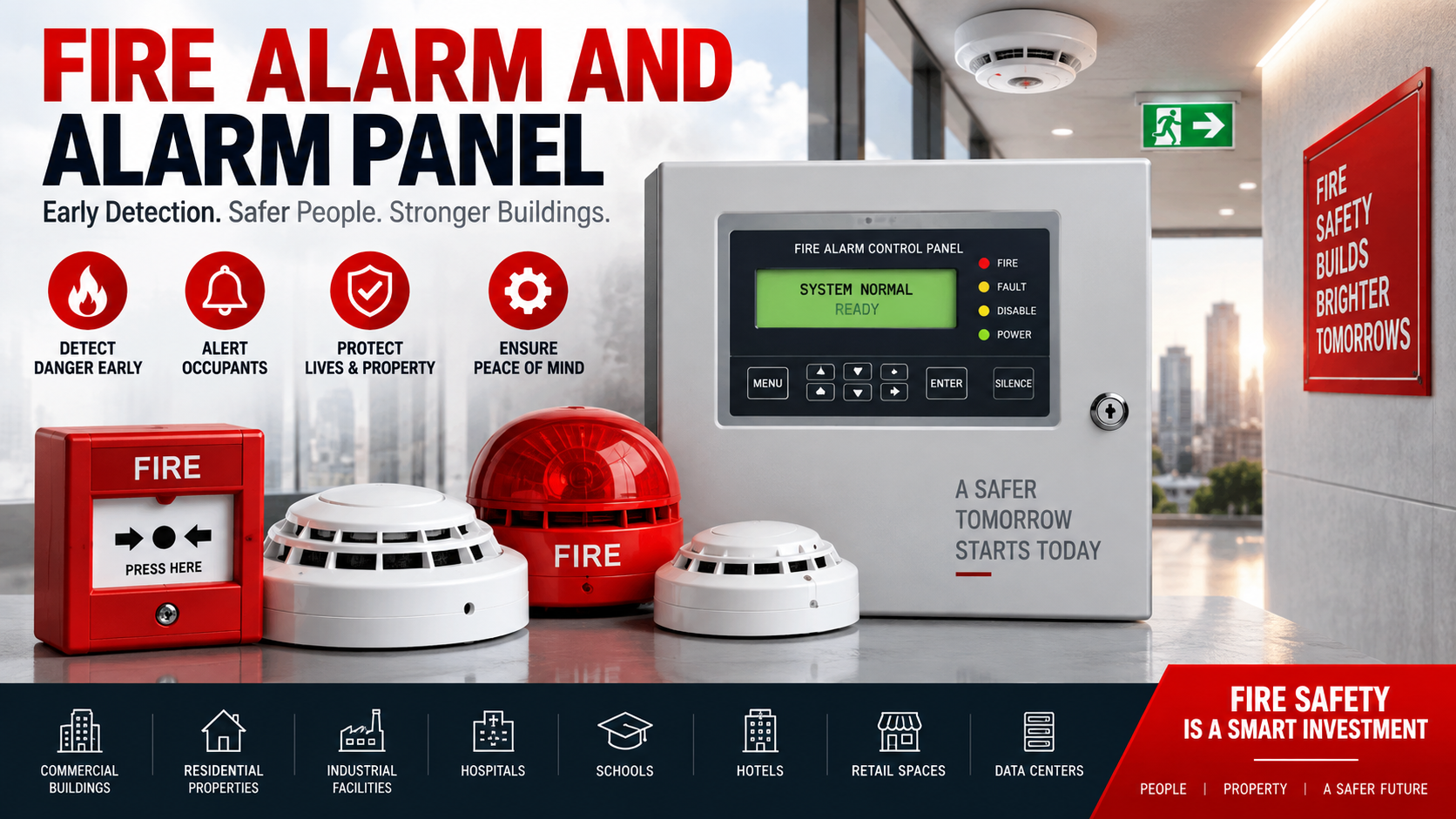
A fire can spread within minutes, causing serious damage to buildings, equipment, and human lives. Having a reliable fire detection and warning system is essential for identifying potential dangers early and allowing people to respond quickly. Two important components of any modern fire protection setup are the fire alarm and alarm panel.
These systems work together to detect fire-related threats, process warning signals, and alert occupants before a dangerous situation becomes uncontrollable. Whether you manage an office, shopping centre, factory, school, hospital, or residential building, understanding how these components work can help you make better fire safety decisions.
What Is a Fire Alarm and Why Is It Important?
A fire alarm is a safety device or interconnected system designed to detect signs of fire, such as smoke, excessive heat, or flames. Once a potential fire is identified, the system activates audible and visual warnings to notify people inside the building.
The main purpose of a fire alarm is to provide an early warning so occupants can evacuate safely and emergency responders can be contacted.
Modern fire detection systems offer several important benefits:
-
Early Fire Detection: Identifies potential fire hazards before they spread.
-
Life Protection: Gives occupants valuable time to evacuate.
-
Property Safety: Helps reduce damage to buildings and valuable equipment.
-
Emergency Awareness: Alerts people through sirens, bells, and flashing lights.
-
Business Continuity: Helps organisations improve workplace safety and emergency preparedness.
Installing a suitable fire alarm is an important step towards creating a safer environment.
Understanding the Role of an Alarm Panel
An alarm panel, commonly known as a fire alarm control panel (FACP), is the central operating unit of a fire detection system. It receives information from connected detectors, monitors system conditions, and activates appropriate warning devices when necessary.
Think of the alarm panel as the brain of the entire fire protection system. It continuously monitors connected devices and communicates important information to building occupants or authorised personnel.
Its primary functions include:
-
Receiving signals from smoke and heat detectors.
-
Identifying the location or zone of a potential fire.
-
Activating connected sounders and visual indicators.
-
Monitoring wiring faults and power supply problems.
-
Displaying system warnings and emergency conditions.
-
Supporting authorised testing, inspection, and maintenance.
A properly selected alarm panel helps ensure that the complete fire detection system operates efficiently.
Different Types of Fire Alarm Systems
Every building has different safety requirements. Therefore, selecting the right fire detection arrangement depends on building size, layout, occupancy, and potential fire risks.
1. Conventional Fire Alarm System
A conventional system divides a building into multiple detection zones. When a detector activates, the control panel identifies the affected zone rather than the exact detector.
It is commonly suitable for smaller buildings, offices, shops, and compact commercial properties.
2. Addressable Fire Alarm System
An addressable system assigns a unique identification address to individual connected devices. This allows the alarm panel to identify the specific detector or device reporting an alarm.
Its advantages include:
-
More accurate fire location identification.
-
Easier fault detection.
-
Improved monitoring capabilities.
-
Better suitability for large buildings.
3. Wireless Fire Alarm System
Wireless systems use radio communication to connect detectors and other components with the control unit.
They can be useful in existing buildings where installing extensive cables may be difficult. However, battery condition, radio signal strength, and system compatibility require regular attention.
Important Components of a Fire Alarm System
A complete fire detection arrangement includes several interconnected devices. Each component performs a specific function.
|
Component |
Main Function |
|---|---|
|
Smoke Detector |
Detects smoke particles in the air |
|
Heat Detector |
Identifies abnormal temperature increases |
|
Manual Call Point |
Allows occupants to activate an alarm manually |
|
Sounder |
Produces an audible warning |
|
Strobe Light |
Provides a visible warning signal |
|
Alarm Panel |
Receives signals and controls system responses |
|
Backup Battery |
Supports operation during power interruptions |
These components work together to provide dependable fire detection and warning coverage.
How Does a Fire Alarm and Alarm Panel Work Together?
The working process is straightforward but highly important. When a detector identifies smoke or excessive heat, it sends an electrical or wireless signal to the alarm panel.
The panel processes the incoming signal and determines the appropriate response according to its programming and system configuration.
The general working process includes:
-
Detection: A smoke or heat detector identifies a possible fire condition.
-
Signal Transmission: The detector sends information to the control panel.
-
Signal Processing: The panel evaluates the received signal.
-
Alarm Activation: Connected sounders, bells, or visual indicators activate.
-
Emergency Response: Occupants follow the building’s evacuation procedure.
Important: Fire alarm systems should be designed and configured by qualified professionals according to applicable fire safety requirements.
Fire Alarm vs Alarm Panel: Understanding the Difference
Although these terms are closely connected, they perform different functions within a fire protection system.
|
Feature |
Fire Alarm |
Alarm Panel |
|---|---|---|
|
Main Purpose |
Detects or warns about fire |
Controls and monitors the system |
|
Primary Role |
Provides warning signals |
Processes incoming information |
|
Connected Devices |
Detectors and notification devices |
Detectors, call points, and sounders |
|
Operation |
Detection and notification |
Monitoring and control |
|
Importance |
Alerts building occupants |
Coordinates system operation |
Both are essential for creating an effective fire detection and warning arrangement.
Where Are Fire Alarm Systems Commonly Used?
A professionally installed fire alarm system can improve safety across different types of properties.
Common applications include:
-
Residential Buildings: Apartments, houses, and residential complexes.
-
Commercial Offices: Corporate workplaces and business centres.
-
Industrial Facilities: Manufacturing units, warehouses, and factories.
-
Educational Institutions: Schools, colleges, and training centres.
-
Healthcare Facilities: Hospitals, clinics, and medical centres.
-
Retail Properties: Shopping malls, supermarkets, and showrooms.
-
Hotels: Guest rooms, kitchens, corridors, and common areas.
The system should be selected according to the building’s occupancy, fire risks, and applicable safety regulations.
Tips for Choosing the Right Alarm Panel
Choosing the correct alarm panel is important for reliable fire detection and long-term performance.
Consider these factors before purchasing:
-
Building Size: Select a system with sufficient capacity for the property.
-
System Type: Compare conventional, addressable, and wireless options.
-
Device Compatibility: Ensure that detectors and notification devices are compatible.
-
Expansion Options: Consider future building extensions and additional detection points.
-
Power Backup: Check battery backup arrangements.
-
Compliance: Confirm that the equipment meets applicable fire safety standards.
-
Professional Support: Choose products supported by qualified installation and maintenance services.
A professional assessment can help identify the most suitable solution.
Maintenance Practices for Better Fire Safety
Even high-quality equipment requires regular inspection and maintenance. A poorly maintained system may fail to provide an effective warning during an emergency.
Follow these essential practices:
-
Test detectors and manual call points according to the maintenance schedule.
-
Inspect the alarm panel for fault indicators.
-
Check backup batteries and power connections.
-
Ensure sounders and visual indicators function correctly.
-
Keep detectors free from dust and obstructions.
-
Maintain inspection and testing records.
-
Arrange servicing through qualified fire safety technicians.
Never ignore a warning or fault indication. Investigate the cause promptly and restore the system to normal operation.
Frequently Asked Questions (FAQs)
1. What is a fire alarm?
A fire alarm is a detection and warning system that identifies potential fire conditions and alerts people inside a building.
2. What is an alarm panel?
An alarm panel is the central control unit that receives signals from connected devices and manages system warnings.
3. What is the main purpose of a fire alarm?
Its main purpose is to provide early warning, helping occupants evacuate and respond to potential fire emergencies.
4. How does an alarm panel detect fire?
It receives signals from connected smoke detectors, heat detectors, and manual call points.
5. What is the difference between conventional and addressable systems?
Conventional systems identify the affected zone, while addressable systems can identify individual devices.
6. Can a fire alarm work during a power failure?
Yes. Properly designed systems generally include backup batteries to maintain operation during mains power interruptions.
7. Where should fire alarm systems be installed?
They are commonly installed in homes, offices, factories, hospitals, schools, hotels, and commercial buildings according to applicable requirements.
8. How often should a fire alarm be inspected?
Inspection and testing frequency depends on local regulations, manufacturer recommendations, and the building’s fire safety plan.
9. Why is alarm panel maintenance important?
Regular maintenance helps identify faults, maintain system reliability, and ensure connected devices operate correctly.
10. Which fire alarm system is suitable for large buildings?
Addressable systems are often suitable for large and complex buildings because they provide more precise device identification.
11. Can an alarm panel identify a faulty detector?
Many modern panels can identify specific device faults or affected circuits, depending on the system type and configuration.
12. Who should install a fire alarm system?
A qualified fire safety professional should design, install, test, and commission the system according to applicable standards.










Leave a Reply