
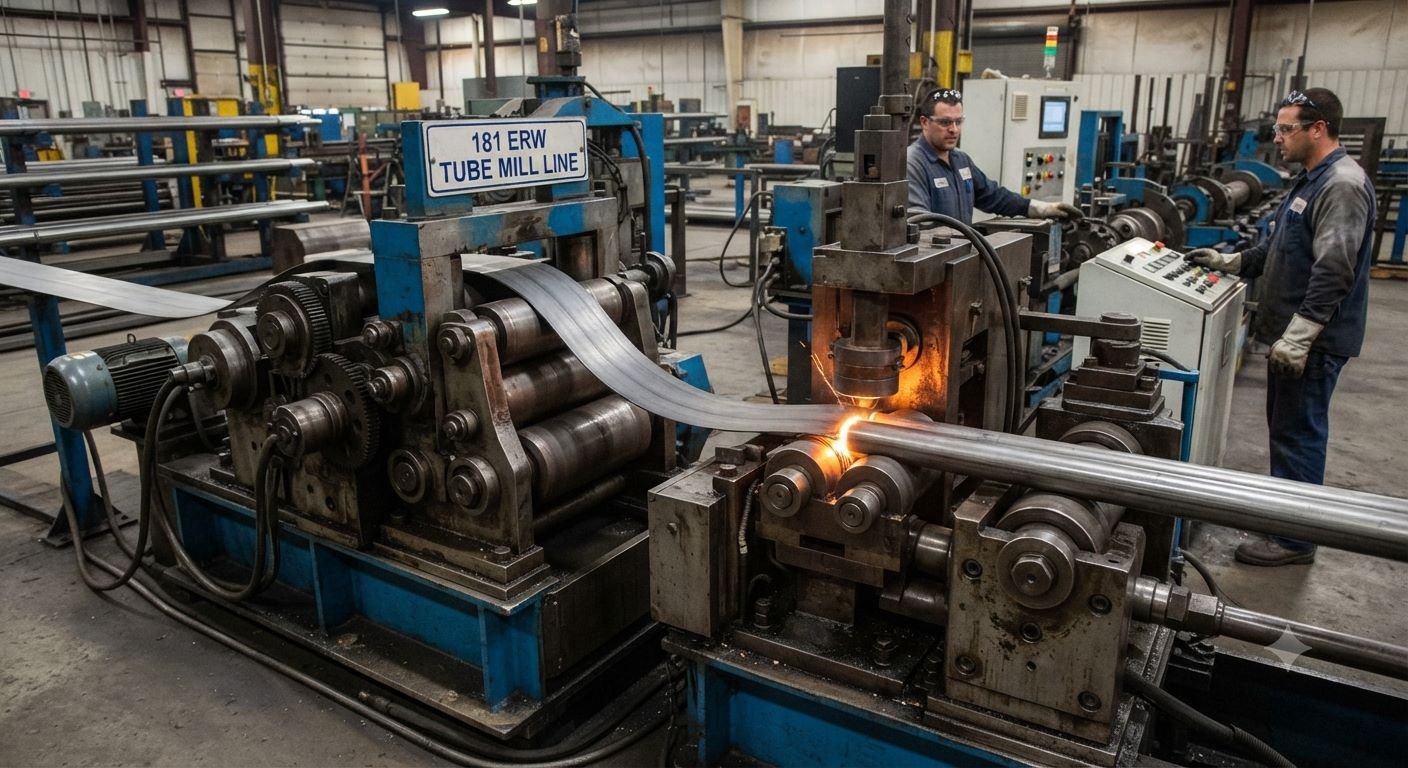
The steel tube manufacturing industry plays an essential role in construction, automotive production, infrastructure, engineering, and various industrial applications. As demand for durable, accurate, and cost-effective steel tubes continues to increase, manufacturers need advanced machinery that delivers consistent quality and high production efficiency. An ERW Tube Mill Line is an important solution for businesses looking to manufacture high-quality welded steel tubes with precision and reliability.
A modern Tube Mill Line combines several manufacturing processes, including strip feeding, forming, welding, sizing, and cutting, into one integrated production system. With suitable automation and machine configuration, manufacturers can improve productivity, reduce material waste, and maintain consistent tube dimensions.
What Is an ERW Tube Mill Line?
An ERW (Electric Resistance Welding) Tube Mill Line is an industrial production system designed to manufacture steel tubes by continuously forming flat steel strips into a circular shape and joining their edges through electric resistance welding.
During production, the steel strip passes through a series of forming rollers. Once the edges meet, electrical resistance generates the heat required to create a strong welded joint. The tube then moves through sizing and finishing sections to achieve the required diameter and shape.
Key components generally include:
-
Uncoiler for holding and feeding steel coils.
-
Strip joining and accumulation equipment.
-
Forming section for shaping the steel strip.
-
High-frequency welding system.
-
External weld bead removal equipment.
-
Sizing and straightening section.
-
Flying cutting machine.
-
Run-out table and collection system.
Each component contributes to smooth production and helps maintain the required manufacturing standards.
Understanding the Working Process of a Tube Mill Line
A Tube Mill Line operates through a continuous manufacturing process. Every stage is designed to transform flat steel material into finished tubes.
1. Coil Loading and Uncoiling
The process begins with loading a steel coil onto the uncoiler. The equipment gradually releases the strip and feeds it into the production line at a controlled speed.
2. Strip Preparation
The strip edges are prepared and joined when necessary to maintain continuous production. An accumulator stores material and helps the mill operate during coil changes.
3. Forming and Shaping
The steel strip passes through multiple roller stations that gradually transform it into a cylindrical or tubular shape.
4. High-Frequency Welding
The edges of the formed strip are heated using electrical resistance and pressed together to create a continuous longitudinal weld. Welding parameters must be properly controlled to achieve reliable joint quality.
5. Sizing and Straightening
After welding, the tube passes through sizing rollers. This stage ensures dimensional accuracy, roundness, and straightness according to the required specifications.
6. Cutting and Collection
The finished tube is cut into predetermined lengths using a flying saw or cutting system. The products are then collected for inspection, packaging, and transportation.
Major Benefits of an ERW Tube Mill Line
Investing in a properly designed ERW Tube Mill Line can offer several operational advantages.
-
High production efficiency: Continuous processing supports faster manufacturing and reduces unnecessary interruptions.
-
Consistent product quality: Precision rollers and controlled welding help maintain uniform tube dimensions.
-
Reduced material waste: Accurate forming and cutting can improve material utilization.
-
Automation capabilities: Modern control systems simplify production monitoring and machine operation.
-
Flexible manufacturing: Suitable configurations can support different tube sizes and wall thicknesses.
-
Cost-effective production: Efficient processing can help reduce operating costs over the long term.
Applications of Products Manufactured by Tube Mill Line
Steel tubes produced through ERW technology serve a wide range of industries.
| Industry | Common Applications |
|---|---|
| Construction | Structural tubes, scaffolding, and support systems |
| Automotive | Vehicle components and structural parts |
| Furniture | Metal frames and furniture structures |
| Agriculture | Irrigation and farming equipment |
| Infrastructure | Fencing, poles, and general fabrication |
| Industrial manufacturing | Mechanical tubes and equipment components |
The versatility of ERW production makes it valuable for manufacturers serving multiple industrial markets.
How to Select the Right Tube Mill Line
Choosing suitable equipment requires careful consideration of production requirements and long-term business objectives.
Consider these important factors:
-
Production capacity: Select a machine that matches your expected output and manufacturing targets.
-
Tube specifications: Evaluate the required diameter range, wall thickness, and material grades.
-
Welding technology: Check the welding system’s performance, control features, and compatibility.
-
Automation level: Consider PLC controls and monitoring systems for improved operational consistency.
-
Machine construction: Look for durable frames, precision rollers, and reliable mechanical components.
-
Technical support: Evaluate installation assistance, spare parts availability, and after-sales service.
A detailed technical discussion with the equipment manufacturer can help determine the most suitable configuration.
ERW Tube Mill Line vs. Conventional Tube Manufacturing
| Feature | Modern ERW Tube Mill Line | Conventional Production |
|---|---|---|
| Production method | Continuous resistance welding | Depends on manufacturing method |
| Automation | Advanced automation options | May involve more manual operations |
| Productivity | Designed for continuous output | Can involve additional production stages |
| Dimensional control | Precision roller-based sizing | Depends on equipment |
| Flexibility | Configurable for different tube specifications | Depends on machinery |
The right manufacturing system ultimately depends on product requirements, investment capacity, and production volume.
Frequently Asked Questions
1. What is an ERW Tube Mill Line?
It is an industrial machine system that manufactures steel tubes by forming flat steel strips and welding their edges using electrical resistance.
2. What does ERW stand for?
ERW stands for Electric Resistance Welding, a process that joins metal edges through electrically generated heat and pressure.
3. What materials can an ERW Tube Mill process?
Depending on its configuration, it can process suitable grades of carbon steel, low-alloy steel, and other compatible materials.
4. What are the main components of a Tube Mill Line?
Major components include an uncoiler, forming section, welding system, sizing rollers, cutting machine, and collection equipment.
5. Which industries use ERW steel tubes?
Construction, automotive, furniture, agriculture, infrastructure, and industrial manufacturing are common users.
6. Can one Tube Mill Line produce different tube sizes?
Yes. A suitably designed mill can manufacture different tube sizes through appropriate tooling changes and machine adjustments within its specified operating range.
7. What determines the production speed?
Production speed depends on tube dimensions, material thickness, welding capacity, machine design, and operating conditions.
8. Is an ERW Tube Mill Line suitable for continuous production?
Yes. It is specifically designed for continuous tube manufacturing, with accumulators and other systems supporting production continuity.
9. How can manufacturers maintain tube quality?
Regular maintenance, accurate roller alignment, controlled welding parameters, and appropriate inspection procedures help maintain product quality.
10. What should buyers check before purchasing a Tube Mill Line?
Buyers should evaluate production capacity, tube specifications, machine construction, automation, energy requirements, installation support, and warranty conditions.








Leave a Reply