
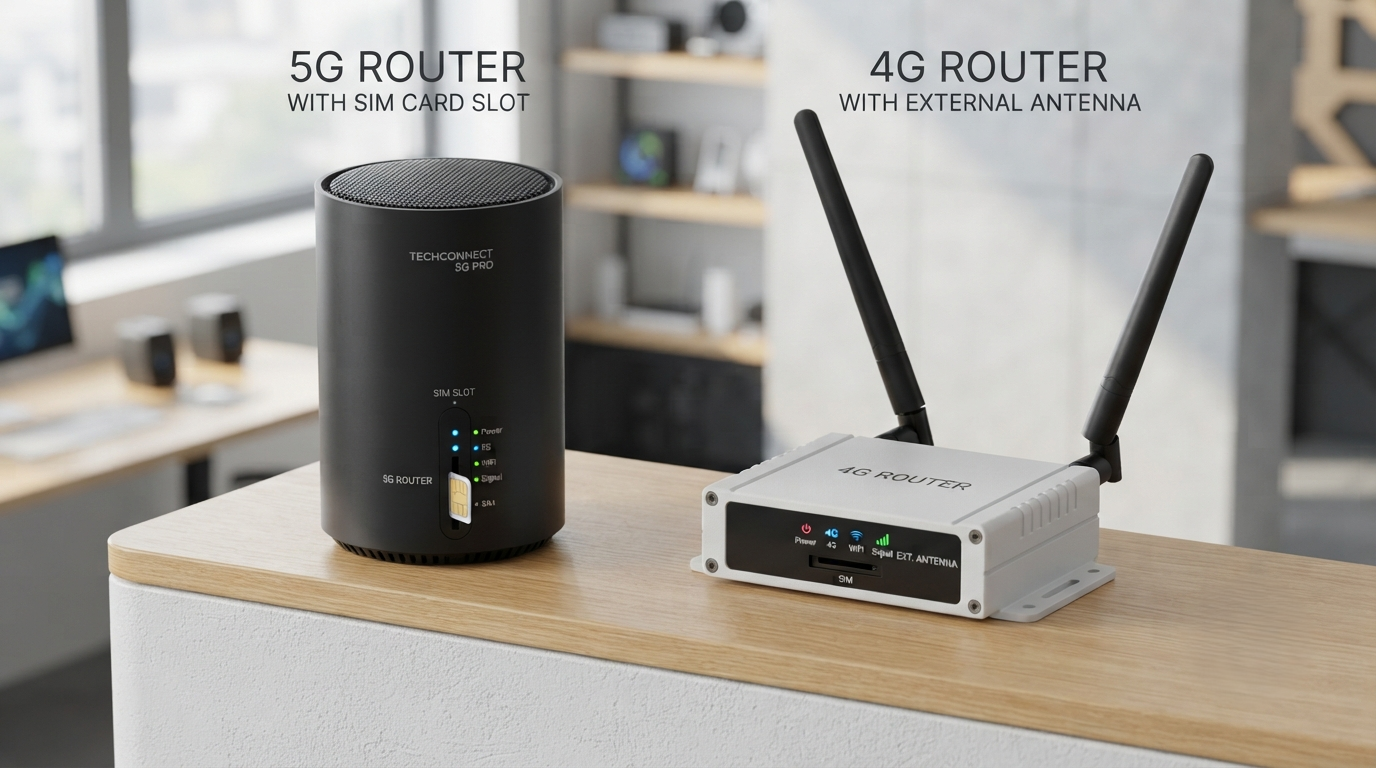
Whether you need internet for online meetings, video streaming, smart devices, or everyday browsing, choosing the right router can make a significant difference. Two popular options are a 5G router with SIM card slot and a 4G router with external antenna. Both provide internet access through mobile networks without requiring a traditional wired broadband connection.
However, they offer different advantages in terms of speed, coverage, signal reception, and performance. Understanding these differences will help you select a router that matches your internet requirements and budget.
What Is a 5G Router with SIM Card Slot?
A 5G router with SIM card slot is a wireless networking device that connects to a 5G mobile network using a compatible SIM card. Instead of depending on fibre or cable broadband, it receives mobile internet signals and distributes the connection to multiple devices through Wi-Fi or Ethernet ports.
These routers are suitable for users who want faster internet speeds and flexible connectivity.
Key Features of a 5G SIM Router
-
High-speed connectivity: Supports faster downloads and uploads where 5G coverage is available.
-
SIM card compatibility: Uses a supported mobile network SIM.
-
Multiple device connections: Connects smartphones, laptops, smart TVs, and other devices.
-
Wi-Fi connectivity: Distributes internet wirelessly throughout the coverage area.
-
Ethernet ports: Allows wired connections for computers and other equipment.
-
Low latency: Can provide responsive connectivity for video calls, gaming, and online applications.
A 5G router is particularly useful for modern households and businesses that require high-speed internet for multiple activities.
What Is a 4G Router with External Antenna?
A 4G router with external antenna is designed to connect to a 4G LTE mobile network and distribute internet through Wi-Fi or wired connections. Its external antenna helps improve signal reception, especially in locations where mobile network signals are weak.
Unlike standard routers with built-in antennas, these models may feature detachable or adjustable external antennas that can be positioned for better reception.
Benefits of a 4G Router with External Antenna
-
Improved signal reception: External antennas can help capture available mobile signals more effectively.
-
Reliable connectivity: Useful in areas with moderate or weak 4G coverage.
-
Flexible installation: Antennas can be adjusted or upgraded on compatible models.
-
Affordable solution: Generally costs less than many 5G routers.
-
Easy setup: Insert a compatible SIM card and configure the network settings.
-
Wide availability: 4G networks remain accessible across many locations.
A 4G router is a practical option for homes, small offices, shops, and rural properties where 5G coverage is limited.
5G Router with SIM Card Slot vs 4G Router with External Antenna
Although both routers provide wireless internet through SIM cards, their performance and applications can differ.
| Features | 5G Router | 4G Router with External Antenna |
|---|---|---|
| Network support | 5G, often 4G fallback | 4G LTE |
| Internet speed | Potentially much faster | Depends on LTE coverage |
| Signal reception | Depends on antenna design | External antennas can improve reception |
| Latency | Generally lower on suitable 5G networks | Generally higher |
| Cost | Usually higher | Usually more affordable |
| Best suited for | High-speed internet needs | Budget-conscious connectivity |
| Network availability | Requires 5G coverage | Uses widely available 4G coverage |
The best choice depends on your location, network provider, internet usage, and available budget.
How to Choose the Right Router for Your Needs
Before purchasing a router, consider these important factors.
1. Check Network Coverage
Network availability should be your first consideration. A 5G router cannot deliver 5G performance without suitable 5G coverage. Similarly, a 4G router requires a stable LTE signal.
Check the coverage provided by your mobile network operator before making a decision.
2. Consider Internet Speed Requirements
If your household regularly streams high-resolution videos, downloads large files, or operates multiple connected devices, a 5G router may be a better investment.
For everyday browsing, emails, online classes, and basic office work, a good 4G router may be sufficient.
3. Evaluate Antenna Performance
An external antenna can make a meaningful difference when the router receives weak mobile signals. However, antenna compatibility, frequency bands, placement, and router design all affect results.
Look for routers that support suitable external antennas if signal reception is a concern.
4. Check SIM Card Compatibility
Always confirm whether the router supports your network provider’s SIM card, frequency bands, and required network settings.
Some devices may also have carrier restrictions or specific APN configuration requirements.
Where Can You Use These Routers?
Both router types offer flexible internet connectivity across different environments.
5G router applications:
-
Modern homes requiring high-speed internet.
-
Business offices with multiple users.
-
Temporary workspaces and commercial locations.
-
Internet-intensive applications and entertainment.
4G router applications:
-
Rural homes and remote properties.
-
Small shops and retail businesses.
-
Construction sites and temporary offices.
-
Backup internet connections.
-
Locations with limited 5G coverage.
Important Features to Check Before Buying
Use this checklist to make a smarter purchase:
-
Supported 4G and 5G frequency bands.
-
SIM card compatibility.
-
Wi-Fi generation and coverage.
-
Number of Ethernet ports.
-
External antenna connector availability.
-
Maximum supported connected devices.
-
Security features and firmware updates.
-
Warranty and after-sales support.
Do not select a router based only on its advertised maximum speed. Real-world performance depends on network congestion, signal quality, distance from the tower, and service provider limitations.
Frequently Asked Questions
1. What is a 5G router with SIM card slot?
It is a wireless router that uses a SIM card to access a 5G mobile network and shares the internet connection with connected devices.
2. Is a 5G router better than a 4G router?
A 5G router can offer faster speeds and lower latency, but its advantages depend on local 5G coverage and network conditions.
3. What is the purpose of an external antenna in a 4G router?
An external antenna helps the router receive mobile network signals and may improve connectivity in areas with weak reception.
4. Can I use a normal SIM card in a 5G router?
Yes, provided the SIM, mobile plan, frequency bands, and router are compatible with the network operator.
5. Does a 4G router with external antenna improve internet speed?
It can improve performance when poor signal reception is the main problem. However, it cannot overcome network congestion or an operator’s speed limitations.
6. Can a 5G router work with a 4G SIM card?
Some 5G routers support 4G LTE fallback, but compatibility depends on the device and SIM provider.
7. Which router is suitable for rural areas?
A 4G router with an appropriately positioned external antenna can be a practical option where 4G coverage is available but 5G is unavailable.
8. Can multiple devices connect to these routers?
Yes. Both router types can support multiple devices, although the actual limit depends on the router specifications and network performance.
9. Do these routers require fibre broadband?
No. Both use mobile network connectivity through a SIM card, so a traditional fibre connection is not necessary.
10. What should I check before buying a SIM-based router?
Check network compatibility, supported frequency bands, Wi-Fi specifications, antenna options, SIM support, warranty, and expected internet usage.










Leave a Reply