
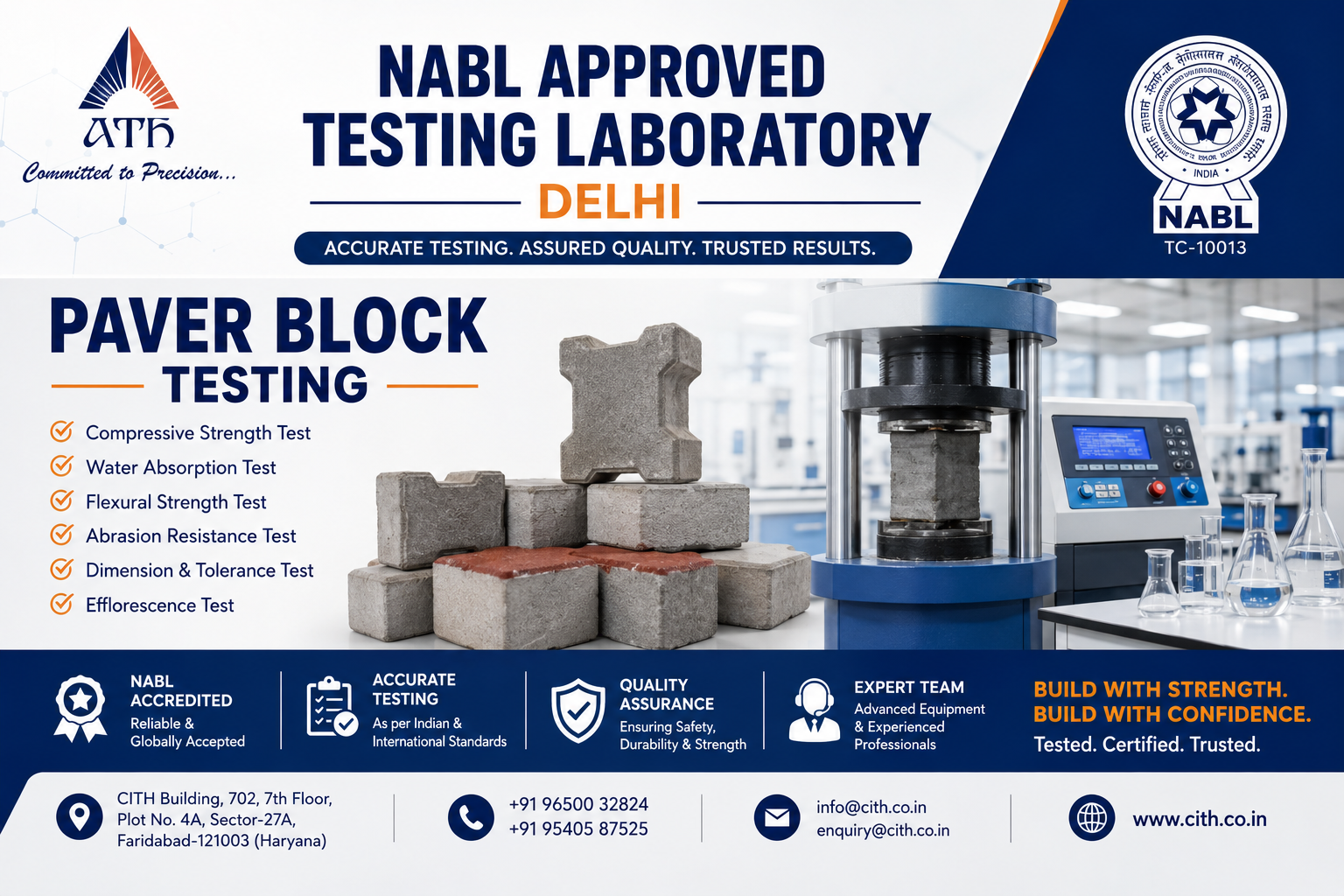
Quality assurance is essential for construction projects where material failure can result in additional costs, repairs, delays, and customer dissatisfaction. Paver blocks are no exception. Because these materials are used in areas subjected to regular traffic and environmental exposure, appropriate Paver Block Testing can provide important information about their quality.
A NABL Approved Testing Laboratory Delhi can support construction-material evaluation by conducting tests within its recognized scope and using appropriate procedures.
Applications of Paver Blocks
Concrete paving blocks are used in numerous applications, including:
- Footpaths
- Residential driveways
- Parking areas
- Pedestrian plazas
- Commercial premises
- Industrial floors
- Landscaping
- Road-related applications
Each application may impose different performance expectations.
Importance of Laboratory Evaluation
A paver’s appearance does not necessarily indicate its internal quality. Testing provides objective measurements that can be used to evaluate the product.
For example, a block may have acceptable dimensions but insufficient compressive strength. Another may have good strength but excessive water absorption.
A combination of appropriate tests provides a more complete understanding.
Key Paver Block Tests
Compressive Strength
This test evaluates resistance to compressive loading. The result is especially relevant when paver blocks are expected to carry pedestrian or vehicular loads.
Water Absorption
This test determines how much water is absorbed under prescribed conditions. The applicable standard specifies maximum permissible values.
Abrasion Resistance
Abrasion testing assesses resistance to surface wear, which can be particularly relevant to areas experiencing repeated traffic.
Dimensional Testing
Laboratories can measure length, width, thickness, and other relevant dimensional characteristics.
Tensile Splitting Strength
This provides additional information about the mechanical behavior of the paving block.
Flexural Strength
Flexural testing evaluates the block’s resistance under bending conditions.
Freeze-Thaw Durability
Where required, freeze-thaw testing can be considered for relevant environmental conditions.
The 2021 BIS documentation identifies these characteristics and associated test procedures under IS 15658.
Importance of Correct Sampling
Testing begins before the specimen reaches the machine. Samples should represent the relevant batch and be selected according to the applicable sampling procedure.
BIS documentation specifies sample quantities for different tests, demonstrating why sampling should not be treated as an informal step.
Benefits for Manufacturers
For manufacturers, routine testing can provide several advantages. It can reveal production variations and help determine whether changes in raw materials or curing practices are affecting performance.
Testing data can also be used to support customer documentation and internal quality records.
Benefits for Purchasers
Purchasers can use independent laboratory results when evaluating supplied paving blocks. This may be particularly useful for large projects where material consistency is critical.
Selecting a Laboratory
When searching online for a NABL Approved Testing Laboratory Delhi, look beyond marketing claims. Accreditation is scope-specific. Confirm that the laboratory is currently accredited for the required test methods.
This step is particularly important if the report will be submitted to a client, government department, consultant, certification body, or project authority.
Professional Reporting
A useful report should clearly identify the sample and explain the test methodology and results. It should allow the reader to understand what was tested and under which standard.
Clear reporting improves traceability and reduces confusion during technical reviews.
Frequently Asked Questions
Why is paver block testing required?
Testing helps determine whether paver blocks meet specified physical and mechanical requirements.
Is compressive strength the only important test?
No. Water absorption, abrasion, dimensions, and other characteristics can also be important depending on the application.
Can testing identify manufacturing problems?
Yes. Unexpected results may indicate issues related to mix design, compaction, curing, materials, or other production variables.
What should I check before sending samples?
Confirm sample quantity, sample condition, required tests, applicable standard, test-age requirements, and laboratory submission instructions.
CTA
Protect your construction quality with reliable laboratory evaluation. Select a competent NABL Approved Testing Laboratory Delhi and arrange professional Paver Block Testing according to the applicable project and standard requirements.







Leave a Reply