
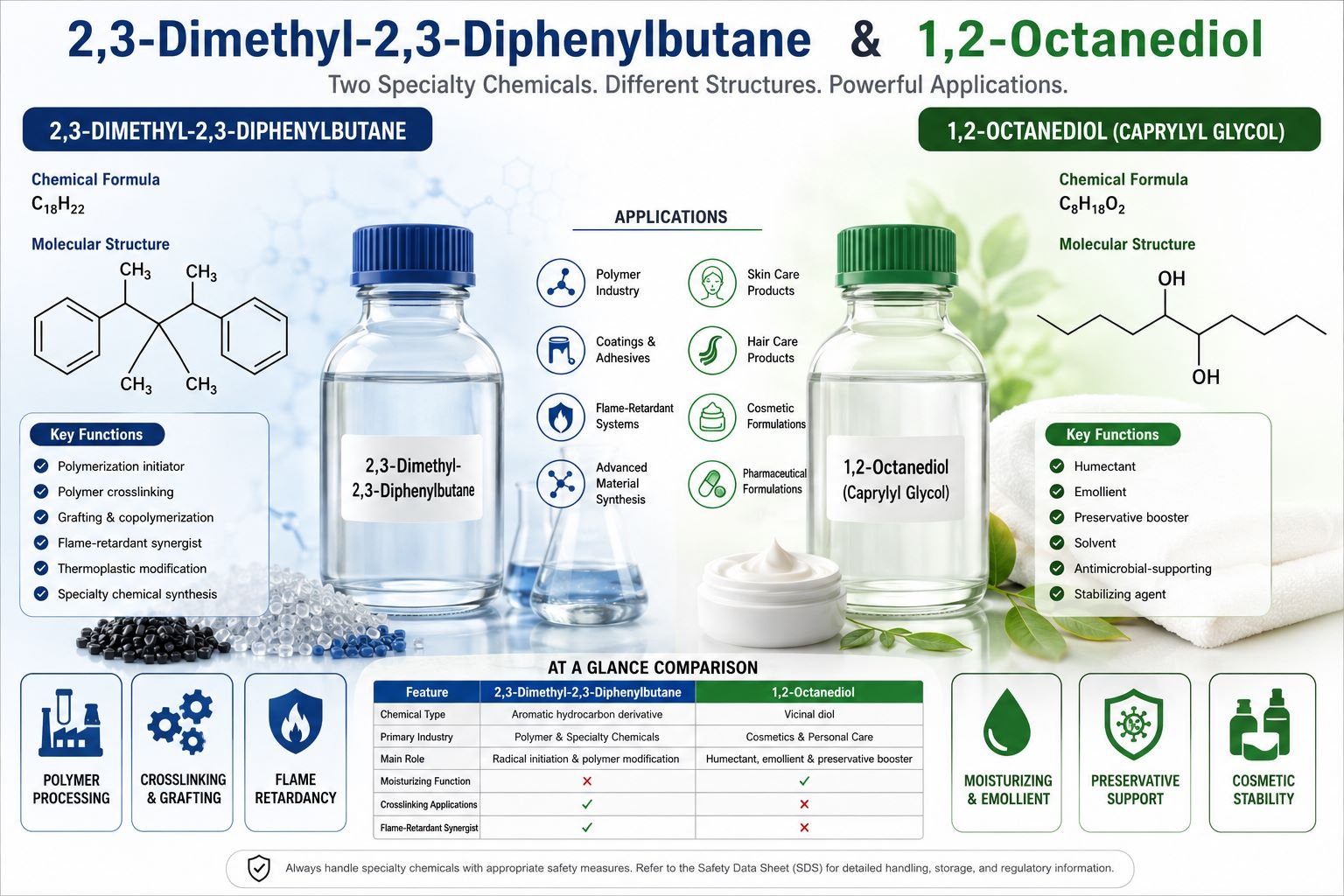
Chemical compounds play an important role in modern manufacturing, industrial research, material development, and personal care formulations. Each compound has its own molecular structure, chemical properties, and potential applications. Two interesting examples are 2,3-dimethyl-2,3-diphenylbutane and 1,2-octanediol, which belong to different chemical categories and serve different purposes.
Understanding these compounds helps manufacturers, researchers, chemical distributors, and formulation specialists make informed decisions about their applications. While 2,3-dimethyl-2,3-diphenylbutane is an organic compound known for its role as a radical initiator, 1,2-octanediol is a multifunctional diol used in cosmetic and industrial formulations.
This article explores their chemical structures, properties, applications, differences, and handling considerations.
Understanding 2,3-Dimethyl-2,3-Diphenylbutane
2,3-Dimethyl-2,3-diphenylbutane is an organic chemical compound containing carbon, hydrogen, and aromatic phenyl groups. It is commonly associated with organic peroxide alternatives and radical-based polymerization chemistry.
Its molecular structure makes it particularly interesting in chemical research and industrial material development.
Chemical Structure and Properties
The compound has a symmetrical molecular structure featuring two phenyl groups attached to a central butane framework.
Some important characteristics include:
-
Chemical name: 2,3-Dimethyl-2,3-diphenylbutane
-
Molecular formula: C18H22
-
Molecular weight: Approximately 238.37 g/mol
-
Chemical category: Organic hydrocarbon
-
Functional characteristics: Aromatic rings and a carbon-carbon central bond
Its structure allows the central carbon-carbon bond to undergo homolytic cleavage under suitable conditions, producing relatively stable carbon-centred radicals.
Industrial Applications
2,3-dimethyl-2,3-diphenylbutane is relevant to radical chemistry and polymer research.
Potential application areas include:
-
Polymer chemistry: Used in studying radical generation and polymerization mechanisms.
-
Chemical research: Helps researchers investigate carbon-carbon bond cleavage.
-
Material development: Relevant to investigations involving polymer modification.
-
Organic synthesis: Provides an example of a compound capable of generating carbon-centred radicals.
Its application depends on reaction conditions, material compatibility, and the requirements of the manufacturing process.
Understanding 1,2-Octanediol
1,2-octanediol is an eight-carbon organic compound containing two hydroxyl groups. It belongs to the diol family of alcohols and is valued for its multifunctional properties.
Unlike conventional single-function alcohols, this compound contains two hydroxyl groups, giving it distinctive characteristics in formulation chemistry.
Chemical Structure and Properties
1,2-octanediol has a linear eight-carbon chain with hydroxyl groups attached to the first and second carbon atoms.
Its key chemical characteristics include:
-
Chemical name: 1,2-Octanediol
-
Molecular formula: C8H18O2
-
Molecular weight: Approximately 146.23 g/mol
-
Chemical category: Aliphatic diol
-
Functional groups: Two hydroxyl groups
The combination of a hydrocarbon chain and two hydroxyl groups contributes to its interaction with different formulation ingredients.
Common Applications of 1,2-Octanediol
1,2-octanediol has applications in several formulation and manufacturing sectors.
1. Cosmetic Formulations
It is used as a multifunctional ingredient in personal care products, including selected skincare and cleansing formulations.
2. Moisturising Products
Its chemical structure supports its use as a formulation ingredient in products designed to improve skin feel and product performance.
3. Preservative Support
It can contribute antimicrobial activity and help support preservation systems in suitable cosmetic formulations. Its effectiveness depends on concentration and the overall formulation.
4. Industrial Formulations
It may also be investigated for applications involving specialty chemical blends and functional formulations.
Key Differences Between Both Chemical Compounds
Although both compounds belong to organic chemistry, their structures and applications are significantly different.
|
Property |
2,3-Dimethyl-2,3-diphenylbutane |
1,2-Octanediol |
|---|---|---|
|
Molecular formula |
C18H22 |
C8H18O2 |
|
Molecular weight |
238.37 g/mol |
146.23 g/mol |
|
Chemical category |
Aromatic hydrocarbon |
Aliphatic diol |
|
Main structural feature |
Two phenyl groups |
Two hydroxyl groups |
|
Chemical functionality |
Radical generation |
Multifunctional alcohol |
|
Application areas |
Polymer and radical chemistry |
Cosmetics and formulations |
Understanding these differences is important when selecting chemicals for research, product development, and manufacturing operations.
How to Select the Right Chemical for Industrial Applications
Choosing between 2,3-dimethyl-2,3-diphenylbutane and 1,2-octanediol depends on the intended application.
Consider the following factors:
-
Application requirements: Identify whether the process requires radical chemistry or a multifunctional alcohol.
-
Chemical compatibility: Evaluate interactions with other ingredients and materials.
-
Purity specifications: Check the required grade and certificate of analysis.
-
Storage conditions: Follow the supplier’s recommended temperature and storage instructions.
-
Regulatory compliance: Review applicable chemical safety and industry requirements.
-
Technical documentation: Examine safety data sheets and product specifications before purchasing.
These considerations help improve product quality and reduce unnecessary formulation or processing problems.
Frequently Asked Questions
1. What is 2,3-dimethyl-2,3-diphenylbutane?
It is an organic hydrocarbon containing two phenyl groups and a central carbon-carbon bond that can generate carbon-centred radicals through suitable bond cleavage.
2. What is the molecular formula of 2,3-dimethyl-2,3-diphenylbutane?
Its molecular formula is C18H22, and its molecular weight is approximately 238.37 g/mol.
3. What is 1,2-octanediol?
It is an eight-carbon organic diol containing two hydroxyl groups, making it useful in various cosmetic and specialty chemical formulations.
4. What is the molecular formula of 1,2-octanediol?
The molecular formula of 1,2-octanediol is C8H18O2.
5. Is 1,2-octanediol used in cosmetics?
Yes. It is used in selected personal care formulations for its multifunctional properties, including its contribution to antimicrobial performance and formulation quality.
6. What makes 2,3-dimethyl-2,3-diphenylbutane chemically interesting?
Its central carbon-carbon bond can undergo homolytic cleavage, making it relevant to research involving free radicals and polymerization chemistry.
7. Are both compounds used for the same purpose?
No. Their molecular structures and chemical functions are different. One is associated with radical chemistry, while the other is used in multifunctional formulations.
8. How should these chemicals be stored?
Storage should follow the manufacturer’s safety data sheet, including recommended temperature, packaging, ventilation, and incompatibility precautions.
9. What industries use 1,2-octanediol?
Its applications include cosmetics, personal care, specialty formulations, and selected industrial chemical applications.
10. Why are chemical purity and quality important?
Purity affects chemical performance, consistency, compatibility, and product quality. Buyers should review technical specifications and certificates of analysis.
Read more –
https://sportgalax.com/read-blog/27126
https://devansh-001.livejournal.com/37641.html?newpost=1
https://frendlo.com/blogs/64791/How-Do-2-3-Dimethyl-2-3-Diphenylbutane-and-1
https://article.gofitbuddy.com/ethylhexylglycerin-uses-benefits-and-choosing-the-right-supplier/






Leave a Reply