
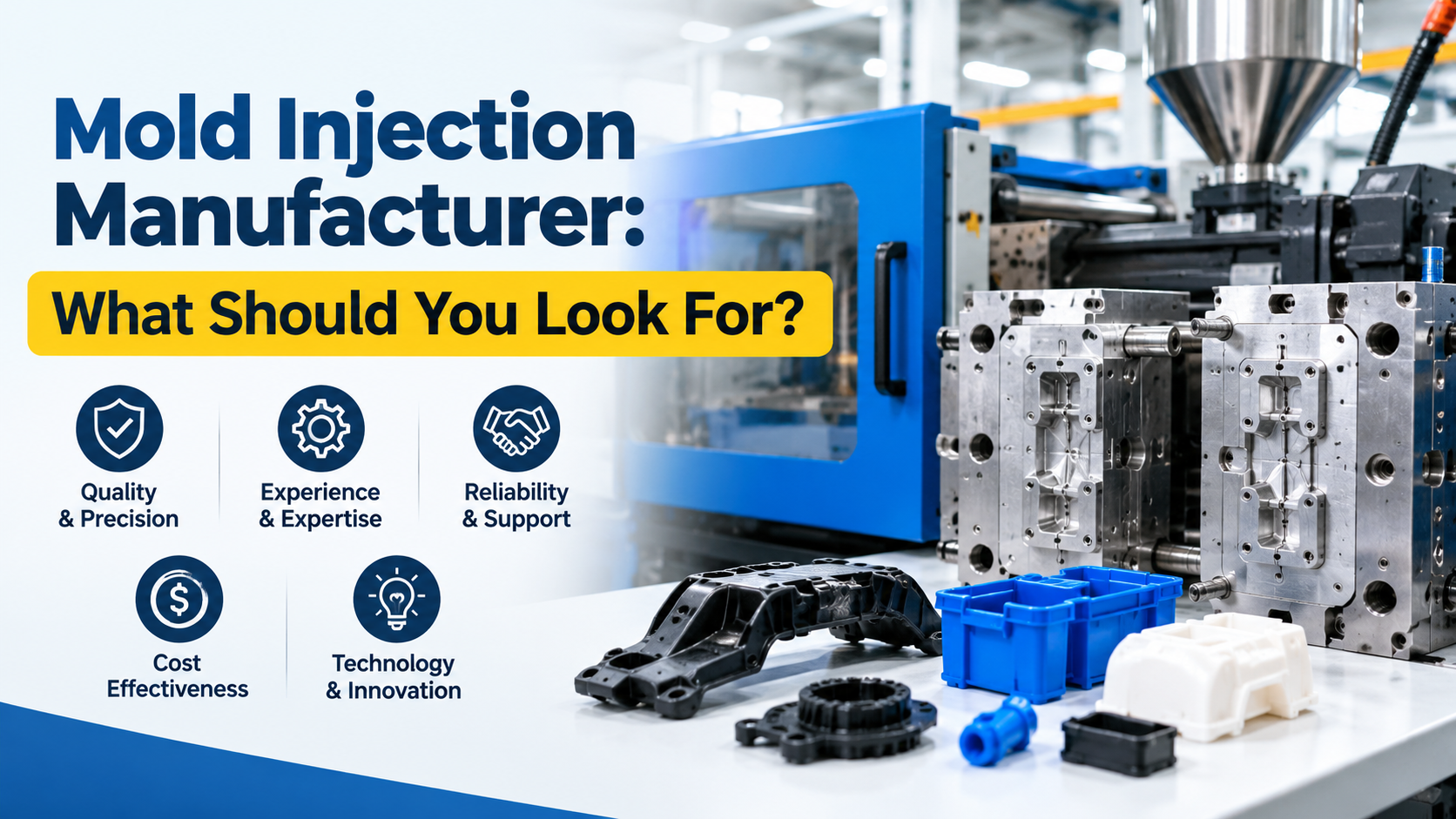
A molded plastic component may appear simple once it leaves the production line. Behind that finished part, however, lies a sequence of engineering decisions. Tool design, material behavior, processing conditions, and inspection can all influence the final result.
Choosing the right Mold Injection Manufacturer therefore involves more than comparing tooling prices. Manufacturers need a partner that understands how design decisions affect production. The right technical approach can help reduce tooling issues, improve repeatability, and support consistent part quality.
Why Does Mold Quality Matter?
The mold determines the geometry that every production part must reproduce. Even small dimensional errors can become significant when repeated across thousands of components. Cavity accuracy is particularly important for parts with tight tolerances. The mold must account for material shrinkage, thermal behavior, and expected processing conditions.
Cooling design also affects performance. Uneven cooling can contribute to warpage, sink marks, and dimensional variation. Properly positioned cooling channels help control heat across the mold. Venting should receive similar attention. Air trapped inside the cavity can cause burns, incomplete filling, or other surface defects.
A well-designed mold addresses these factors before production begins. This reduces the need for corrective work after the tooling is already complete.
What Should You Review Before Tooling Starts?
The best tooling decisions begin with a detailed review of the part design. A manufacturer should examine whether the geometry supports efficient molding. Draft angles are one basic consideration. They help the finished component release from the cavity without excessive force.
Wall thickness also requires careful evaluation. Large variations can affect filling, cooling, and shrinkage. Other features can introduce additional complexity. Ribs, bosses, undercuts, inserts, and deep cavities may require specialized tooling approaches.
Design-for-manufacturing analysis can identify these concerns early. It allows engineers to adjust the design before machining begins. This collaborative stage can also clarify tooling costs. Complex features may require EDM, additional slides, special inserts, or other machining processes.
How Does Custom Plastic Injection Moulding Support Complex Parts?
Custom Plastic Injection Moulding provides flexibility when standard tooling approaches cannot meet specific product requirements. Engineers can design the mold around the part’s geometry, material, and production volume. This flexibility helps with components with unusual dimensions or integrated features. A single molded component may combine mounting points, ribs, clips, channels, and functional surfaces.
Material selection must remain part of this discussion. Different resins have different flow characteristics, shrinkage rates, and temperature requirements. A customized tooling strategy should accommodate these differences. Gate location, runner design, cooling, and ejection can all influence the result.
Production volume also affects the tooling decision. A high-volume component may justify a multi-cavity mold. Lower-volume production may require a different balance between tooling investment and cycle efficiency. The objective is to create a mold that suits the complete manufacturing requirement.
Where Does Precision Become Important?
Not every plastic component requires extremely tight tolerances. However, precision becomes critical when parts must fit, align, seal, or perform consistently. Precision Plastic Injection Molding depends on accurate tooling and stable processing conditions. Cavity dimensions must account for material shrinkage and thermal changes.
Multi-cavity tools require additional attention. Each cavity should produce parts with comparable dimensions and characteristics. Machine settings also affect precision. Injection pressure, speed, melt temperature, holding pressure, and cooling time can influence dimensional results.
Inspection provides another layer of control. Measure critical features against approved engineering specifications. For demanding components, address precision throughout the project. Don’t rely solely on final inspection.
How Does Tooling Influence Production Costs?
The initial mold quotation doesn’t tell the full cost story. A poorly designed tool can drive up costs throughout production. Long cycle times can increase the cost of every molded component. Inefficient cooling can lengthen cycles.
Frequent maintenance can also increase downtime. Select wear components based on production volume and material characteristics. Mold accessibility matters during servicing. Engineers should be able to inspect and replace critical components without unnecessary disassembly.
Material waste represents another consideration. Poor runner design or unstable processing can increase scrap. A well-engineered tool considers these factors from the beginning. The result can be a more predictable production process.
Can Mold Flow Analysis Improve Tool Development?
Mold flow analysis allows engineers to evaluate filling behavior before physical tooling is complete. It can provide useful information about potential manufacturing problems. Simulation can examine filling patterns, pressure requirements, weld lines, air traps, and cooling behavior.
These insights can influence gate locations and runner configurations. They may also identify areas where wall thickness or geometry should be reconsidered. Simulation does not replace practical testing. However, it can help reduce uncertainty before machining begins.
For a Mold Injection Manufacturer, combining simulation with tooling experience provides a stronger basis for design decisions. The value comes from interpreting simulation results correctly. Engineering judgment remains essential when translating digital findings into practical mold features.
What Role Does Prototyping Play?
Prototyping allows manufacturers to evaluate the physical component before full-scale production. A prototype can reveal fit or assembly problems that remain hidden in digital models. It can also provide early feedback about appearance and handling.
For complex products, prototype testing can expose issues with wall thickness, draft, mounting features, or component interfaces. Design revisions are generally easier before you finalize production tooling. Early testing can therefore reduce the risk of expensive changes later.
How Should Quality Be Managed During Production?
Quality control should begin during tooling development. Verify mold dimensions, machining accuracy, and critical components before approving production. Trial parts provide another opportunity for evaluation. Engineers can inspect dimensions, appearance, filling behavior, and ejection performance.
During production, keep process parameters within established limits. Changes in temperature, pressure, cycle time, or material behavior can affect consistency. Inspection methods should match the component’s requirements. CMM measurements, visual inspection, scanning, and functional testing may all have a role.
Choosing the Right Manufacturing Approach
A reliable molding strategy connects design, tooling, materials, processing, and inspection. Treating these stages separately can create gaps that become costly later. Custom Plastic Injection Moulding can accommodate specialized components, but success depends on engineering decisions. Tool design must reflect material behavior and production requirements.
Likewise, Precision Plastic Injection Molding requires more than precise machining. Stable processing, accurate inspection, and appropriate tooling design must work together. Manufacturers should also consider communication when evaluating suppliers. Engineering changes, drawing revisions, material specifications, and inspection requirements need clear coordination.
Selecting a Manufacturing Partner
The right Mold Injection Manufacturer should provide more than a finished tool. Engineering support, mold development, machining, inspection, and production expertise can all influence project outcomes.
For manufacturers evaluating Precision Plastic Injection Molding or specialized tooling, an integrated technical approach can simplify development. Careful planning connects the first design review to dependable production results.
Pioneer Plastech (Shenzhen) Ltd. provides mold manufacturing, injection molding, DFM analysis, precision machining, and inspection capabilities. Its engineering resources support complex tooling and plastic manufacturing projects across multiple industries.









Leave a Reply