
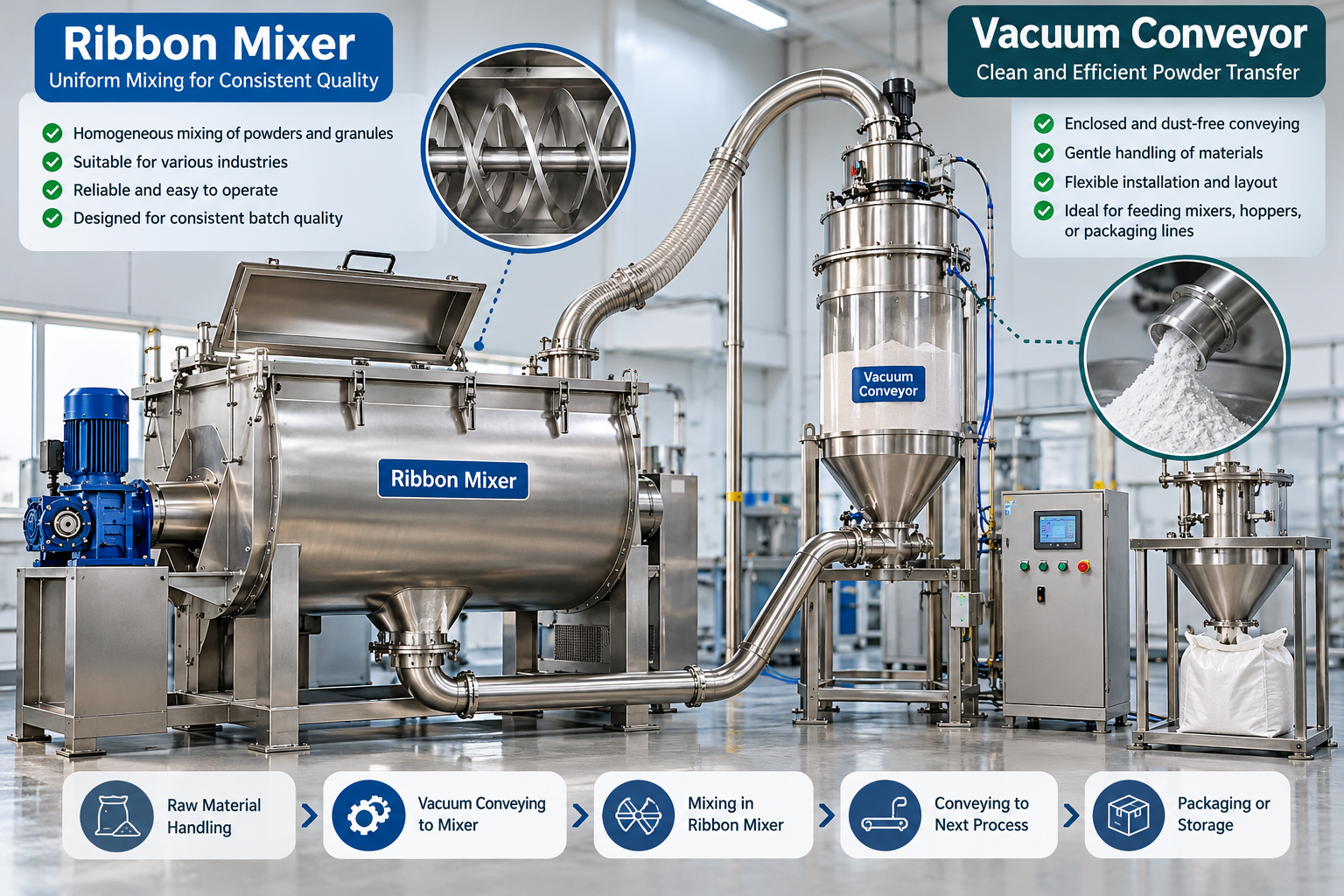
In modern manufacturing industries, maintaining product quality, improving production efficiency, and reducing material handling costs are essential. Industries dealing with powders, granules, chemicals, food ingredients, pharmaceuticals, and other bulk materials require reliable equipment to achieve these goals. Two important machines that support these operations are the ribbon mixer and vacuum conveyor.
A ribbon mixer ensures uniform blending of different materials, while a vacuum conveyor provides a clean, efficient, and automated method of transferring materials from one location to another. When used together, these machines can improve production workflows, minimize manual handling, and maintain consistent product quality.
This article explains how these machines work, their benefits, applications, and how businesses can select the right equipment for their manufacturing requirements.
What Is a Ribbon Mixer?
A ribbon mixer is an industrial mixing machine designed to blend dry powders, granules, and similar bulk materials. It generally consists of a horizontal U-shaped mixing chamber containing a rotating shaft fitted with inner and outer helical ribbons.
As the shaft rotates, the ribbons move materials in opposite directions, creating continuous circulation inside the mixing chamber. This movement helps achieve a consistent blend within a relatively short mixing time.
Ribbon mixers are widely used in industries where accurate and uniform mixing is important.
Key Features of a Ribbon Mixer
-
Uniform mixing: Helps distribute ingredients throughout the batch.
-
Strong construction: Designed for demanding industrial operations.
-
High capacity: Available in different sizes to suit production requirements.
-
Easy operation: Simple operating mechanisms support efficient production.
-
Customizable design: Can be manufactured using materials such as stainless steel.
-
Low maintenance: Properly designed equipment can offer reliable long-term performance.
How Does a Ribbon Mixer Work?
The working principle of a ribbon mixer is based on mechanical movement and material circulation.
The mixing process generally involves these steps:
-
Material loading: Raw materials are introduced into the mixing chamber.
-
Ribbon rotation: The motor drives the central shaft and helical ribbons.
-
Material movement: The outer ribbon moves material in one direction, while the inner ribbon moves it in the opposite direction.
-
Blending: Continuous movement promotes uniform distribution of ingredients.
-
Discharge: Once the required mixing time is achieved, the finished material is released through the discharge outlet.
The final mixing quality depends on factors such as material characteristics, batch size, ribbon design, and operating speed.
What Is a Vacuum Conveyor?
A vacuum conveyor is an automated material handling system that transfers powders, granules, and other suitable bulk materials through pipelines using vacuum pressure.
Instead of relying on manual transportation, this system uses a vacuum pump or blower to create negative pressure. Material is drawn from a source into the conveying line and transported to a receiving vessel.
Vacuum conveying is particularly useful in industries that require hygienic production environments, controlled material movement, and reduced dust generation.
Important Features of a Vacuum Conveyor
-
Dust-controlled transfer: Helps reduce airborne powder during material transportation.
-
Automated operation: Minimizes manual material handling.
-
Enclosed conveying: Keeps materials inside a closed pipeline.
-
Flexible installation: Can connect different machines and production areas.
-
Improved hygiene: Suitable designs support hygienic manufacturing environments.
-
Reduced material loss: Helps minimize spillage during transportation.
How Does a Vacuum Conveyor Work?
A vacuum conveyor operates through a controlled suction-based process.
The working procedure generally includes:
-
The vacuum pump generates negative pressure inside the conveying system.
-
Material is drawn from the storage hopper, container, or feeding point.
-
The material travels through a sealed conveying pipeline.
-
A receiving vessel separates the material from the conveying air.
-
Filters retain particles while cleaned air passes through the filtration system.
-
The collected material is discharged into the connected machine or storage container.
This automated process helps maintain a smoother material flow and reduces the need for manual transportation.
Ribbon Mixer vs Vacuum Conveyor: Understanding the Difference
Although both machines are used in industrial manufacturing, their primary functions are different.
|
Comparison |
Ribbon Mixer |
Vacuum Conveyor |
|---|---|---|
|
Main function |
Mixing materials |
Transferring materials |
|
Working principle |
Mechanical ribbon movement |
Vacuum pressure |
|
Main application |
Powder blending |
Powder transportation |
|
Operation |
Batch mixing |
Automated material conveying |
|
Major benefit |
Consistent blending |
Controlled material transfer |
|
Common industries |
Food, chemical, pharmaceutical |
Food, chemical, pharmaceutical |
Both systems perform different tasks but can work together in an integrated production line.
Industrial Applications of Ribbon Mixer and Vacuum Conveyor
The ribbon mixer and vacuum conveyor are useful across multiple manufacturing sectors.
1. Food Processing Industry
Food manufacturers use these machines to handle and process ingredients such as flour, sugar, spices, milk powder, and seasoning blends.
A ribbon mixer helps achieve consistent ingredient distribution, while a vacuum conveyor transfers raw materials without unnecessary manual contact.
2. Pharmaceutical Industry
Pharmaceutical production requires controlled processing and careful material handling.
These machines can support the processing of suitable powders and granules. Hygienic construction, appropriate filtration, and validated cleaning procedures are important considerations.
3. Chemical Industry
Chemical manufacturers use ribbon mixers for blending dry chemical ingredients and vacuum conveyors for transporting compatible powders.
Equipment selection should consider material properties, corrosion resistance, and potential explosion hazards.
4. Cosmetic Industry
Cosmetic manufacturers use powder mixing and conveying equipment to process ingredients for products such as face powders, dry formulations, and other cosmetic materials.
5. Agricultural Industry
These systems can also support fertilizer blending, animal feed production, and the handling of agricultural powders and granules.
Benefits of Using Ribbon Mixer and Vacuum Conveyor Together
Combining a ribbon mixer with a vacuum conveyor can create a more efficient manufacturing process.
The vacuum conveyor transfers raw materials into the mixing system, while the ribbon mixer blends them according to the required formulation.
Important benefits include:
-
Improved productivity: Automated transportation reduces material loading time.
-
Better process control: Consistent material feeding supports repeatable production.
-
Reduced labor requirements: Less manual material movement is necessary.
-
Cleaner operations: Enclosed conveying helps control dust and spillage.
-
Better workflow: Machines can be integrated into continuous or batch-based production lines.
-
Reduced contamination risks: Properly designed systems limit unnecessary material exposure.
How to Choose the Right Industrial Equipment
Selecting the right equipment requires understanding your production requirements.
Consider these important factors:
-
Production capacity: Determine the required batch size and hourly material transfer rate.
-
Material characteristics: Evaluate particle size, density, moisture content, flowability, and abrasiveness.
-
Construction material: Select suitable contact materials, such as SS304 or SS316, depending on application requirements.
-
Cleaning requirements: Check whether the equipment supports easy inspection and cleaning.
-
Automation: Consider automatic controls, sensors, and integration with existing machinery.
-
Safety standards: Evaluate dust collection, grounding, and explosion protection where necessary.
-
Maintenance: Choose equipment with accessible components and reliable technical support.
Frequently Asked Questions
1. What is the main purpose of a ribbon mixer?
A ribbon mixer is used to blend dry powders and granules to achieve a uniform mixture for industrial manufacturing.
2. Which materials can be processed in a ribbon mixer?
It can process suitable materials such as flour, sugar, spices, chemicals, fertilizers, pharmaceutical powders, and feed ingredients.
3. What is a vacuum conveyor used for?
A vacuum conveyor transfers powders and granules through enclosed pipelines using negative pressure.
4. Is a vacuum conveyor suitable for food processing?
Yes. Food-grade vacuum conveying systems can transfer suitable food ingredients while supporting hygienic production practices.
5. Can a ribbon mixer and vacuum conveyor work together?
Yes. A vacuum conveyor can automatically feed materials into a ribbon mixer, reducing manual handling and improving production efficiency.
6. What is the difference between a ribbon mixer and a blender?
A ribbon mixer is a specific type of industrial blender that uses helical ribbons to circulate and combine materials.
7. Which stainless steel is suitable for industrial mixers?
SS304 and SS316 are commonly considered. The appropriate grade depends on the material being processed, corrosion risks, and hygiene requirements.
8. Does a vacuum conveyor reduce dust?
An enclosed vacuum conveying system with properly selected filters and seals can significantly reduce dust release during material transfer.
9. How do I maintain a ribbon mixer?
Regularly inspect the motor, gearbox, bearings, seals, discharge valve, and ribbon assembly. Follow the manufacturer’s cleaning and maintenance instructions.
10. How do I select the capacity of a vacuum conveyor?
Consider the required conveying rate, distance, vertical lift, material bulk density, particle characteristics, and pipeline configuration.





Leave a Reply